Every year on 20 January, the feast of Saint Sebastian is celebrated, also known as ‘Chorizo Day’. On this day, residents head to San Sebastián Natural Park, a communal pasture that welcomes thousands of people. There, they spend the day with family and friends, enjoying food brought from home. There is no shortage of morcones (sausages), chorizos (spicy sausages), or San Sebastián breads or ‘roscas’ (ring-shaped pastries).
Since the 1920s, a song has been sung on this day that refers to San Sebastián Day in Bollullos. It is a Carnival song written by José Acosta ‘Acostita’, a famous and renowned comparsista (Carnival singer) of the time, who was also mayor of the municipality. The lyrics are as follows:
‘On San Sebastián Day, we went to the countryside to eat the chorizos of all the years. I know a girl, you see, you see, who went home crying her eyes out. And she said to her mother, “Mum, I want a chorizo of a quarter and a half.” And her mother said, “I have it here, but you don’t have any money, and that’s for me.”’
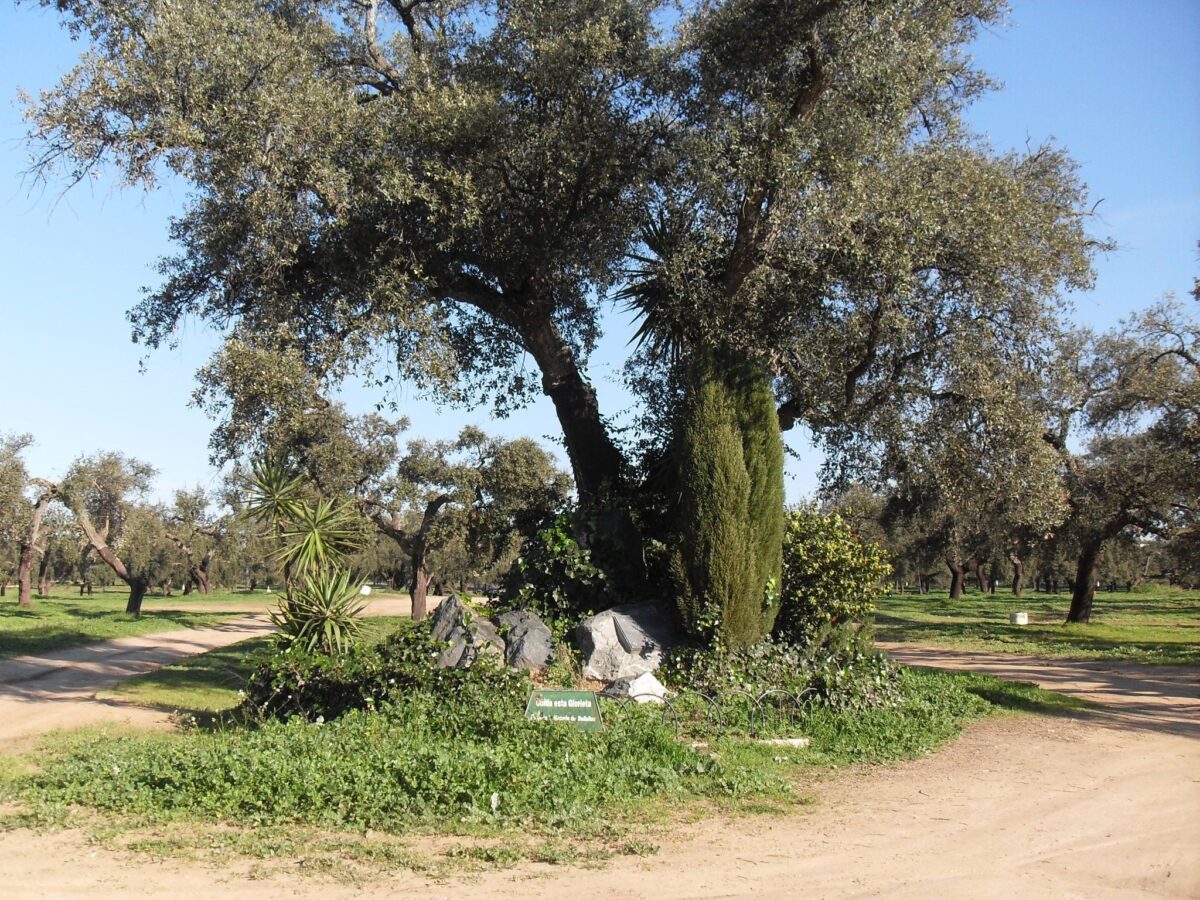
The San Sebastián Natural Park is a communal pasture on the outskirts of the municipality, characterised by a huge cork oak forest that is protected by environmental regulations.
It is a bucolic setting where various activities take place, including the famous “Day of the Sausages” or “Day of San Sebastián”, a day of celebration coinciding with the feast day of the saint who gives the park its name.
According to the latest research by several local historians and researchers, this festival may have religious origins, but during the 20th century it became secularised and took on its current form: a day of family and neighbourhood gatherings in which typical products from the pig slaughter are tasted (the main one being the ‘chorizo de guita’, which has become the slogan of the festival), the latest wines from the harvest and the famous ‘naranjas del país’ (local oranges).
With regard to its history, it is worth noting that during the 20th century, the mayor of Bollullos until 1945, D. Manuel Pérez García, initiated a socio-popular struggle to transfer the pastureland, previously owned by the Isern Coto family, to public ownership. The campaign arose as a reaction to the continuous loss of cork oaks due to the planting of eucalyptus, an invasive species. In 1980, the cause was taken up by the San Sebastián Natural Park Association, which succeeded in acquiring 18 hectares in 1983 and another two in 1984 for the construction of the current children’s playground. Finally, in 1989, the land was transferred to the municipality and became public property.