




Category: Manzanilla
Ermita de San Roque
It is located at the entrance to Mansilla from Villalba del Alcor. Its position recalls the protective function of the place, which is linked to the dedication to San Roque, patron saint of plague epidemics.
Rectangular in shape, its architecture is very simple and traditional. The central niche houses the image of the Virgin of Victory, created by Merino Román in 1938. San Roque is also by the same sculptor and dates from the same year. He is depicted in pilgrim’s garb and carries a silver staff decorated with rocaille, from the late 18th century.
Casa de los Osornos
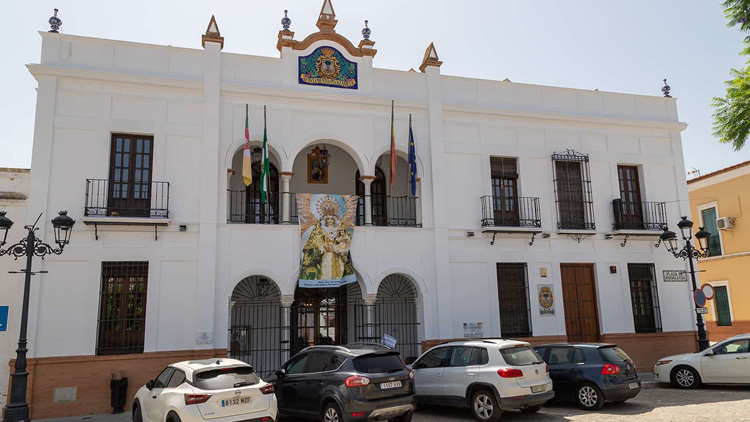
This stately home is located on Manuel Félix Osorno Street and was the Brigadier’s main residence. His home occupied an entire block and had its own chapel dedicated to the Virgin of Solitude, which is now occupied by the Town Hall.
It consists of two sections with a main façade composed of double pilasters, moldings with lugs, and a cornice with moldings hanging from the center to the keystone of the door. The attic is composed of double pilasters that center the composition; it is crowned with fleurs-de-lis and bears the Osorno coat of arms. It has an interior hall with a neoclassical doorway composed of Doric-Tuscan pilasters, with an entablature decorated with triglyphs above which a balcony opens.
Inside the room there is a carved wooden door with the family emblems, the AVE MARÍA and the JHS, also from the late 18th century. In the hallway there is a tile depicting the family’s favorite devotion: the Virgin of Solitude, kneeling, with her hands clasped and her heart pierced by seven swords, a burst of sharp, flaming rays, a crown with imperial symbols and a halo. She is dressed in a sky blue tunic and purple cloak, and two cherubs can be seen in the upper corners.
Santuario de Nuestra Señora del Valle
Located in the area of Vado de San Nicolás, on the outskirts of Manzanilla, the Sanctuary of Nuestra Señora del Valle is an important spiritual and heritage landmark in the County of Huelva. Its origins date back to the 15th century when, according to tradition, the animal carrying the image of the Virgin from Seville stopped at this spot, which was interpreted as a divine sign to build the sanctuary there.
The current structure of the temple dates from the 18th century, thanks to the expansion promoted by Don Gonzalo José de Osorno, canon of Seville Cathedral. The building has a Latin cross plan, with three doorways leading to the interior, highlighting the transept with a semi-spherical vault and the presbytery, which houses a niche dedicated to the Virgin.
The image of Our Lady of the Valley, patron saint and perpetual mayor of Manzanilla, is the work of Sevillian sculptor Antonio Castillo Lastrucci, renowned for his work in religious imagery.
The sanctuary is also the epicenter of the Royal Fair of the Valley, a celebration that brings together numerous faithful and visitors each year, reflecting the deep devotion and cultural tradition of the town.
This sanctuary is not only a place of worship, but also a living testimony to the history and identity of Manzanilla, inviting reflection and discovery of its rich heritage.
Ruta Villalba-Manzanilla
The Villalba del Alcor – Manzanilla Hiking Trail is a route of approximately 6 kilometers that connects both towns through a landscape typical of the Huelva County. The route begins by taking the Almonte road for the first kilometer and a half, then turning left towards Manzanilla.
Along the way, hikers pass through fields of grain, vines, and olive trees, which offer a palette of colors and textures that vary depending on the season. The environment combines fertile crop areas with sandier areas, providing an enriching visual and sensory experience.
This route is suitable for people of average physical fitness and can be done on foot or by bicycle. At the end of the tour, visitors have the opportunity to explore the local wineries in Manzanilla, known for their wine-making tradition.
Ruta “Manzanilla-Chucena”
This route runs between two well-known towns in the county: Manzanilla and Chucena. Although it is not difficult, it may require a little effort because it takes longer and therefore requires greater stamina. It is worth it for the beautiful landscape that will accompany you along the way. On one side, there are extensive fields of crops, which offer a variety of colors and textures, and on the other, there is a forest area, which offers a more monotonous landscape, as it is a eucalyptus grove. Visually, it contrasts with the previous section, as in this case, given the flatness of the terrain and the characteristics of these plantations, there is a total visual closure once inside the eucalyptus forest.
Leaving Manzanilla, there are mainly Mediterranean crops, olive trees, and vines, reflecting the olive and wine-growing tradition of the municipalities of Manzanilla and Chucena.
After 2.5 km, you will have two options: continue on the main route or take the alternative route (short route). If you choose the former, you will have to cross the eucalyptus forest to reach the border between the municipalities of Manzanilla and Villalba del Alcor. The path becomes sandier and therefore more difficult. You will have to continue across the bridge over the A-49 and follow the path that leads to the so-called “Camino de la Palma” or “Vereda de Hinojos.”
Once there, you will be able to see the riverside vegetation that accompanies the Arroyo del Algarbe stream on your right, with holm oaks, poplars, and aspens, along with an important birdlife that is difficult to observe frequently: collared flycatchers, blackcaps, bonelli’s warblers, and tree sparrows.
Continue along the Camino de Purchena or Camino de Almonte, which leads directly to the town of Chucena. On the way to Manzanilla, you can visit the Ermita de Nuestra Señora del Valle, the patron saint of the town, where a pilgrimage is held in June.
Real Feria del Valle
The Royal Fair of the Manzanilla Valley is one of the most emblematic festivals in the County of Huelva, with historical roots dating back to the 18th century. Its origins date back to the reign of Philip V, who, in gratitude for the active participation of the people of Manzanilla in the War of Succession, granted them the privilege of holding a tax-free fair in honor of Our Lady of the Valley, patron saint of the town.
Today, this fair is held in June and has evolved into a typical Andalusian fair, with a large, flat fairground that houses booths and attractions for the enjoyment of locals and visitors alike. In the center of the fairgrounds stands the chapel of the patron saint, from where the procession of Our Lady of the Valley departs on the Thursday of the fair, keeping alive the religious devotion that gave rise to this celebration.
Despite the changes over time, the Royal Fair of the Valley retains its traditional character as a place for the exchange of goods. Although symbolic, a livestock fair specializing in horses is still held outside the fairgrounds.
Organized by the Manzanilla City Council and the Brotherhood of Nuestra Señora del Valle, this festival combines religious, cultural, and recreational elements, offering a unique experience that reflects the identity and traditions of Manzanilla.
Mercado de abastos
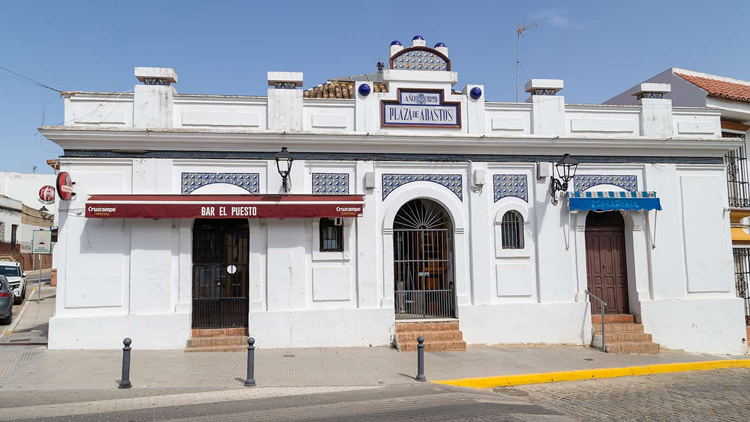
Built in 1929, it is a square-shaped building that originally served as a granary and inn. Its main façade features a linteled opening topped with two corbels, a smooth frieze, and a mutilated cornice. The interior has been modified over time, with two floors and an off-center courtyard. Externally, the building is covered with a gabled roof, and its load-bearing walls are perforated by small openings. The combination of whitewashed walls with ornamental wrought iron and ceramic elements gives it a distinctive character.
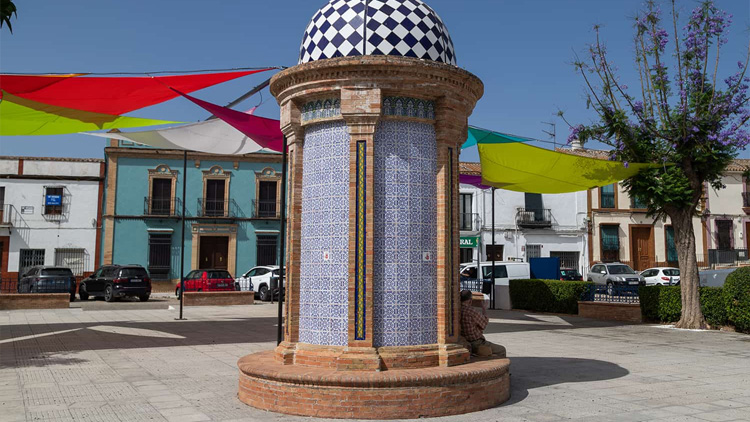
This market is located in the Plaza de Andalucía, the nerve center of Manzanilla, next to the Town Hall. The square is surrounded by plants and benches, and features a central pavilion called Morabito, built in brick and ceramic, which is an old fountain.
The Mercado de Abastos is not only a place of architectural interest, but also a space that reflects the history and traditions of the municipality. In 1994, the building underwent a complete renovation, based on a project by Francisco José López Amate.
Iglesia de Nuestra Señora de la Purificación
The Church of Nuestra Señora de la Purificación, located in Plaza de España in Manzanilla, is the main parish church in the municipality and a outstanding example of Andalusian religious architecture. Its initial construction dates back to 1555, in the Mudejar style, although its current configuration is the result of renovations undertaken in the 18th century after the damage suffered in the Lisbon earthquake of 1755.
These renovations incorporated Baroque and Neoclassical elements, giving it its current appearance.
The church has a Latin cross plan with three naves separated by rectangular pillars with attached half-pilasters. The current roofs, built after the Civil War, include barrel vaults in the central nave and the presbytery, groin vaults in the side naves, and a hemispherical dome on pendentives in the transept.
On the exterior, the three-section tower, built between 1760 and 1779 and attributed to the master builders Lucas Cintora and Francisco Díaz Pinto, stands out. This tower, made of exposed brick and decorated with blue ceramics, is considered one of the most beautiful in the province of Huelva and follows an architectural model inspired by the Giralda in Seville.
The church has three 18th-century façades. The Gospel façade, currently the main one after the closure of the façade at the foot of the church, is neoclassical in style and built in exposed brick. On the façade are 18th-century ceramic altarpieces depicting scenes such as the Resurrection of Christ and the Coronation of the Virgin.
Inside, the church houses important movable property, including paintings, altarpieces, and gold and silverwork. Among these, the image of the patron saint, by the sculptor Castillo Lastrucci, stands out.
Declared a Site of Cultural Interest in the Monument category in 2009, the Church of Nuestra Señora de la Purificación is a symbol of Manzanilla’s historical and cultural heritage.
Fiestas de San Roque
The Patron Saint Festivities in honor of San Roque, patron saint of Manzanilla, are celebrated annually on August 15 and 16, coinciding with the feast of Nuestra Señora de la Victoria. These dates are especially significant for the people of Manzanilla, as they combine religious fervor, tradition, and community spirit.
On August 15, the images of San Roque and the Virgin of Victory are transferred from their respective chapels to the parish church of Nuestra Señora de la Purificación, where they remain overnight. The following day, August 16, a solemn procession is held through the streets of the municipality, culminating in the return of both images to their chapels.
In addition to the religious events, the festivities include various cultural and recreational activities, such as musical performances, which encourage the participation and enjoyment of residents and visitors alike.
These celebrations reflect the identity and traditions of Manzanilla, establishing themselves as an unmissable event in the local festive calendar.