The Obelisco de la Partida is a memorial monument that pays tribute to the departure of the discovery ships from Palos de la Frontera in 1492. It is decorated with painted tiles that reproduce the frescoes ‘Poema al Descubrimiento’ (Poem to the Discovery) by the painter Daniel Vázquez Díaz, which can also be found in the Monastery of La Rábida.
This obelisk is located in Plaza Pilar Pulgar, an emblematic place that forms part of the town’s historical route. The square is named after the first female mayor of the Spanish democracy.
The Obelisco de la Partida is not only a symbol of Columbus’s feat, but also an example of the art and culture that characterise Palos de la Frontera. Its presence in the square invites locals and visitors alike to reflect on the crucial role this town played in the discovery of the New World.
La Fontanilla was the public fountain in Palos de la Frontera where, according to tradition, the ships Santa María, Pinta and Niña were supplied with water when they set sail from the port of Palos on 3 August 1492, bound for the Indies. La Fontanilla is the most humble, but also the most original and authentic monument of the so-called Lugares Colombinos (Columbus Sites).
This building is located on the eastern outskirts of the town, at the foot of the small acropolis where the town was established in the Middle Ages, with its castle, and behind the apse of the parish church. It stands on an ancient Roman wellhead and is protected by a small temple or tetrapylon, built in the 13th century in the Mudejar style with bricks, with a quadrangular floor plan and a semi-spherical vault visible from the outside and enclosed by a pyramidal spire. The supporting element consists of four slightly lowered semicircular arches, supported by angular pillars reinforced with stirrups.
The spout was in the centre and, on either side, there were channels through which the water flowed, collecting on the eastern side in a long trough. Recent studies have shown that it was originally plastered and painted with red ochre (almagra) with religious motifs; which, together with the fact that it was located on the road leading into the town, suggests that, in addition to being a public fountain and a place of rest and refreshment for those returning to the town, it may also have been a wayside shrine or station of penance, a place of prayer and reflection where, as well as rest for the body, peace for the soul could be found. In this regard, it would be worth studying its similarities with other wayside shrines in Andalusia, such as the Cruz del Campo, which is closely linked to the origins of Holy Week in Seville.
The Church of San Jorge Mártir is a Gothic-Mudejar style Catholic church, built in the mid-15th century by order of the Counts of Miranda, possibly on top of an earlier 14th-century building.
The church has three Mudejar naves with pointed arches and a Gothic-style chancel, highlighting the beauty of its ribbed vault. The main façade, with its romantic air and Gothic style from the early 15th century, is known as the ‘Gateway to America’. In May 1492, the Royal Pragmatic Decree ordering certain residents of Palos to deliver two caravels to Christopher Columbus was read in the square in front of this gate.
Located on the north side is the Puerta de los Novios (Gate of the Brides and Grooms), built in the Mudejar style with two-coloured brick. It is known for the tradition that couples entered through it to get married and left through the main gate as husband and wife. The sailors, led by the Pinzón brothers and Christopher Columbus, left through this gate for the port in the early hours of 3 August 1492.
Its bell tower, which combines Mudejar and Baroque styles, is also noteworthy. The base is Mudejar in style from the 15th century, while the pyramidal top, with blue and white checkered ceramics, is Baroque from the 18th century, added after the Lisbon earthquake of 1755.
Inside, there is a central nave with a striking Neo-Mudejar ceiling made by a local carpenter in the 20th century. The side naves house chapels dedicated to Saint George, Saint Getulio and Cereal, and the Tabernacle. In the Gospel nave hangs a painting of Christ embracing the cross, dated around 1620.
This building is located on an acropolis on the eastern side of the castle of Palos de la Frontera and was declared a National Monument in 1931 due to its historical and architectural importance.
The Monument to the Discoverers, also known as the Column of the Fourth Centenary, is a commemorative sculpture erected in 1892 to celebrate the fourth centenary of the discovery of America. Located in La Rábida, this monument pays tribute to Christopher Columbus and the sailors and navigators who participated in the Columbian expedition.
Designed by architect Ricardo Velázquez Bosco, the monument features a neoclassical column rising from a hexagonal pedestal. At its summit is a sphere symbolising the known world at the time of Columbus. The base of the monument is adorned with reliefs depicting scenes from Columbus’ voyage and the indigenous peoples of the American continent.
Over the years, the monument has undergone several restorations to preserve its integrity. Between 1963 and 1967, a restoration was carried out that altered some of its original elements. In the 2010s, consolidation work was carried out and lost elements, such as the sphere at the top of the column, were recovered.
The façade of the Town Hall building dates back to 2018 and is a compendium of allegories about the Discovery of America and elements specific to the municipality.
From bottom to top, inside the arcade of arcades, you can see several cartouches with representative places of the town. In addition, under the central balcony, there is an oval depicting the patron saint of the town, Saint George the Martyr.
The chains above the entrance commemorate the royal visits of Their Majesties the King and Queen of Spain in 1981 and 1992, respectively. and the various corbels supporting the balconies and the roof feature alternating anchors and hearts from the border of the town’s coat of arms, which in turn takes them from the coat of arms granted by Emperor Charles to the Pinzón family.
Inside the balcony, the Catholic Monarchs can be seen next to their coats of arms above the windows. To the left of this, Aragon, next to Ferdinand II, who holds in his hand the Royal Provision or Pragmatic of 23 May 1492 (a sanction imposed on certain residents of the town by the Catholic Monarchs, ordering the delivery of two caravels fully ‘fitted out and ready’ for Columbus’ service) and on the right, Castile next to Queen Isabella I.
The Wharf of the Caravels is one of the most emblematic sites on the Route of Columbus’ Landmarks and a landmark in the province of Huelva in terms of historical and cultural dissemination. Opened in 1994 to mark the 500th anniversary of the discovery of America, it is located in La Rábida, very close to the place from which the three caravels set sail in 1492.
This site features a faithful recreation of the ships that made the ocean voyage that changed the course of history: the Santa María, the Pinta and the Niña. Built in the shipyards of Isla Cristina and Punta Umbría between 1990 and 1992, these replicas allow visitors to climb aboard and learn about the sailing conditions of the time, as well as the organisation and resources of the expedition.
The museum complex surrounding the pier includes an interpretation centre, a recreation of a medieval Castilian port, a 15th-century port town and a space called ‘Isla del Encuentro’ (Island of Encounter), which evokes the first contact between Europeans and the indigenous peoples of America. All this makes the Muelle de las Carabelas an immersive and educational experience that highlights not only the historical events of Columbus’ first voyage, but also the cultural and human consequences that resulted from that encounter between worlds.
Due to its historical accuracy, accessibility and visual appeal, the Muelle de las Carabelas has established itself as one of the most visited places in western Andalusia and an essential stop for those who wish to understand the significance of the 1492 voyage.
The River Tinto is a true symbol of the province of Huelva and, in particular, of the Condado region. Rising in the Sierra de Padre Caro, in the town of Nerva, this river flows for approximately 100 kilometres before emptying into the Huelva estuary, where it joins the River Odiel.
Declared a ‘Protected Landscape’, it has characteristics that make it unique from both a landscape and environmental point of view, due to the acidity of its waters and the very high content of heavy metals and ferruginous salts that give it a range of reddish colours and its peculiar appearance. This unique appearance has also made the river a resource for scientific and photographic tourism.
In addition, this acidity means that there is no classic riverside vegetation on its banks and that its shores have ochre colours that give it an otherworldly appearance. Not surprisingly, its unique characteristics have led NASA to investigate its waters due to their striking resemblance to the planet Mars.
One of the characteristic features of this river are the flour mills, built over several centuries due to the province’s wealth of cereals, which can be found along its entire course. These water mills form part of the historical and industrial heritage of the Condado de Huelva region, where there are up to 23 scattered throughout the municipalities of Paterna del Campo, La Palma del Condado, Villarrasa, Niebla, Moguer and Palos de la Frontera.
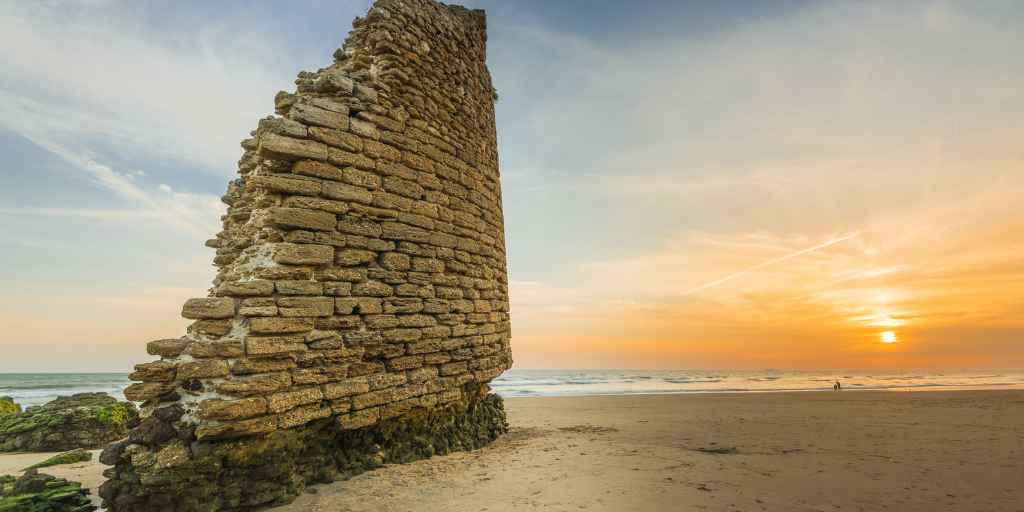
The Torre del Río de Oro, popularly known as the Torre del Loro, is a watchtower declared a Site of Cultural Interest, located on the border between the municipalities of Palos de la Frontera, Almonte, Moguer and Lucena del Puerto. It gives its name to the beach of Torre del Loro. It lies in ruins next to the mouth of a stream, between the Atlantic coast and the foot of the cliff.
The tower was mentioned at the beginning of the 16th century as a powerful watchtower, but a report by Pedro Mateos in 1748 describes the serious damage caused by a storm to the tower’s foundations, threatening to ruin up to a third of them.
In the previous decade, storms had exposed the tower’s foundations, causing alarm, but another storm covered the gap opened by the first, so the alarm was silenced. Both repairs had the technical complication of reinforcing the foundations on the firm ground of a tower located on sand and completely surrounded by the sea at high tide. The solution employed was to create a lining of oyster stone blocks up to a height of seven metres. In 1756, the long-term ruin of the tower was considered inevitable due to its location, surrounded by water and only accessible at low tide. However, the renovations carried out in previous years meant that in 1764 it was observed to be in good condition. In 1827, it was still listed as an active tower in Sebastián Miñano’s Geographical-Statistical Dictionary of Spain and Portugal, although by 1867 it was already listed as in ruins in the coastal charts.