The route between Villalba del Alcor and Paterna del Campo covers approximately 11 kilometres and is ideal for those seeking a hiking experience that combines nature and historical heritage.
The route begins in Villalba del Alcor, taking the Berrocal road. After about 2.5 km, you leave this road and join the Seville-Huelva road. Along the route, you will cross footpaths and rural roads, allowing you to observe farmland that has maintained its essence over the centuries. Most of the route is downhill, making it easy to reach the Aguilones footpath, which leads directly to Paterna del Campo.
At the beginning and end of the route, it is recommended to visit the monuments of both municipalities. In Villalba del Alcor, the church-fortress of San Bartolomé, a building of Almohad origin declared a Site of Cultural Interest, and the convent of San Juan Bautista, founded in 1618 and known for its architecture and Baroque altarpieces, are noteworthy. In Paterna del Campo, you can see the castle of Alpízar, an ancient fortress with an Almohad-style doorway, and the chapel of San Isidro Labrador in the village of Tujena, which dates from 1955 and is the centre of a popular pilgrimage in May.
At the end of the tour, you can enjoy the local cuisine in Paterna del Campo, known for its chickpea stews, traditional sweets and cold meats.
The route from Paterna del Campo to Berrocal is 32 km long with an estimated duration of 8 hours. It is linear and of medium-high difficulty, and can be travelled by bicycle.
The itinerary begins in Paterna del Campo and ascends towards Berrocal, passing through olive groves, eucalyptus forests and cork oak forests. Along the way, you can see the village of Tujena, Alpízar Castle (declared a Site of Cultural Interest) and the Acebuchal de Alpízar (a Site of Community Importance).
At the top of the Cuesta del Carril, you can enjoy sweeping views of the Tinto River gorge, the Sierra de Alcántara and the Pata del Caballo, a national reserve.
The route ends at the Plaza de Andalucía in Berrocal, where the municipality’s Santa Cruz festivities are held.
The route through the Pata del Caballo forest area is a linear itinerary of approximately 23 km of medium-high difficulty. It is suitable for both hikers and cyclists, although some sections require caution.
The route begins in the countryside of Tejada, in the town of Paterna del Campo, and enters the Pata del Caballo forest, an estate of more than 7,000 hectares located in the municipality of Escacena del Campo. The route follows agricultural roads and forest tracks, crossing olive groves and areas of Mediterranean vegetation, such as rockroses and holm oaks.
After the fifth kilometre, the path becomes rocky and more difficult until it reaches Casa del Carnero. This is one of the highlights of the route, offering panoramic views of the Condado countryside. A little further along the track, you can take the short variant of the route to the Castillejos reservoirs and from there join the main route at the Gallinas junction. If you continue along the main route, you will climb up to the Torre del Cejo, one of the highest points in the Condado, which offers one of the most impressive views of the surrounding area.
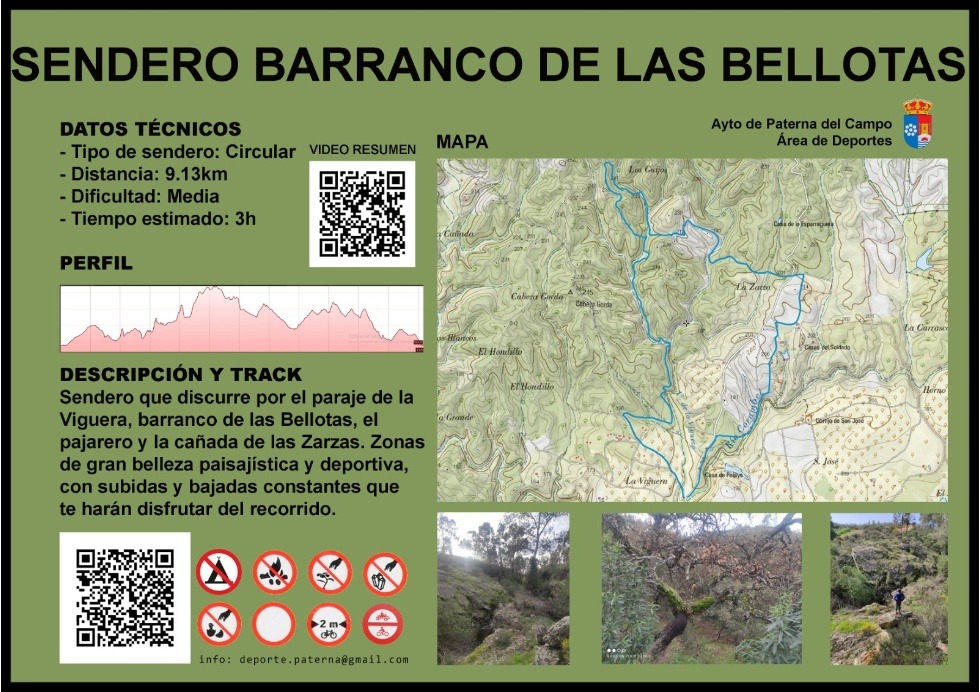
A little further on is the turn-off for the Barranco de los Laureles, a grove classified as unique for its ecological value; and a little later, the second turn-off: the Las Contiendas forest house, recently restored and used for gatherings and meetings. These are two highly recommended options if you have the energy. If not, simply continue along the forest track, passing through Puerta de las Gallinas and La Viguera until you reach the end of the route: the village of Tujena.
It is important to note that some sections of the route, especially from kilometre 5 onwards, are more demanding, with stony paths and wet areas that can make it difficult for bicycles to pass.
The route of the Roman fortifications and mines of the Abadejo ravine offers a hiking trail of some difficulty, ideal for those seeking to combine physical exercise with the discovery of the historical and natural heritage of the area.
The itinerary begins in the vicinity of the Roman mining complex of Torviscoso, located next to the right bank of the Abadejo stream. This enclave is notable for housing a Roman castellum, an ancient fortification that controlled the traffic of ore extracted from the numerous mines in the area.
The route enters a landscape between the Yeguas valley and the Maderos lane, characterised by its impressive views, high altitudes and deep ravines. Along the route, you can see the remains of mining operations dating back to pre-Roman and Roman times, evidence of the intense mining activity that took place in the region.
This trail not only allows you to enjoy a natural environment of great beauty, but also to learn about the mining and military history of the area, offering an enriching experience for lovers of hiking and archaeology.
Starting from the village of Tujena, you can take an interesting hiking route, visiting the old lime kilns in the mountains. Taking the Santa Ana path, you will first come across the so-called ‘Horno de Moya’ (Moya Kiln). The path then continues towards Santa Ana and, from there, to the area known as ‘la Chata’, where you will find a good selection of these kilns, such as the Montaraz, the Legionario and Luis la Chata, among others. To find them, you will need to be accompanied by someone who knows the area well.
The production of quicklime and mortar in the Paterna del Campo mountains involved the application of a series of traditional techniques that were linked to a thousand-year-old tradition spread throughout the Mediterranean arc. From their origins, these ancestral techniques were passed down and continued without major changes until the early 1960s, when they practically disappeared with the widespread use of cement. The technique of firing limestone has its origins in the Neolithic period, but it was the Romans who, at the end of the 3rd century BC, systematically used kilns to produce quicklime, which was then slaked with water and mixed with sand to produce high-quality mortar for their large constructions.
This route requires moderate effort, which is more than rewarded by the fact that it passes through an area with one of the most interesting histories in the province.
The Tartessians, Turdetani, Romans and Almohads walked these paths before the Reconquista. You can see archaeological remains from the former, provided you request permission from the Provincial Council to visit the end of the route: Tejada la Vieja.
This route is a linear 8.3 km walk of low difficulty that begins in the village of Tejada la Nueva, known for its celebration of the pilgrimage of San Isidro Labrador, and continues along livestock trails such as the Colada del Gamonal and the Cañada del Arrebol. After crossing the bridge over the Tejada stream, the path runs parallel to the riverbed, surrounded by vegetation such as reeds, ash trees and eucalyptus, and fields of wheat and sunflowers. When you cross the road to Aznalcóllar, the terrain becomes more uphill, anticipating the proximity of the mountains.
The route ends at the archaeological site of Tejada la Vieja, a Tartessian-Turdetani settlement from the 8th century BC, located on a flat-topped hill in Escacena del Campo. This site, declared a Site of Cultural Interest, preserves the remains of walls up to four metres high, house foundations and a network of streets. From its highest point, there are panoramic views of the countryside and the mountains, including the hill of La Matanza, associated with a historic battle between Christians and Muslims.
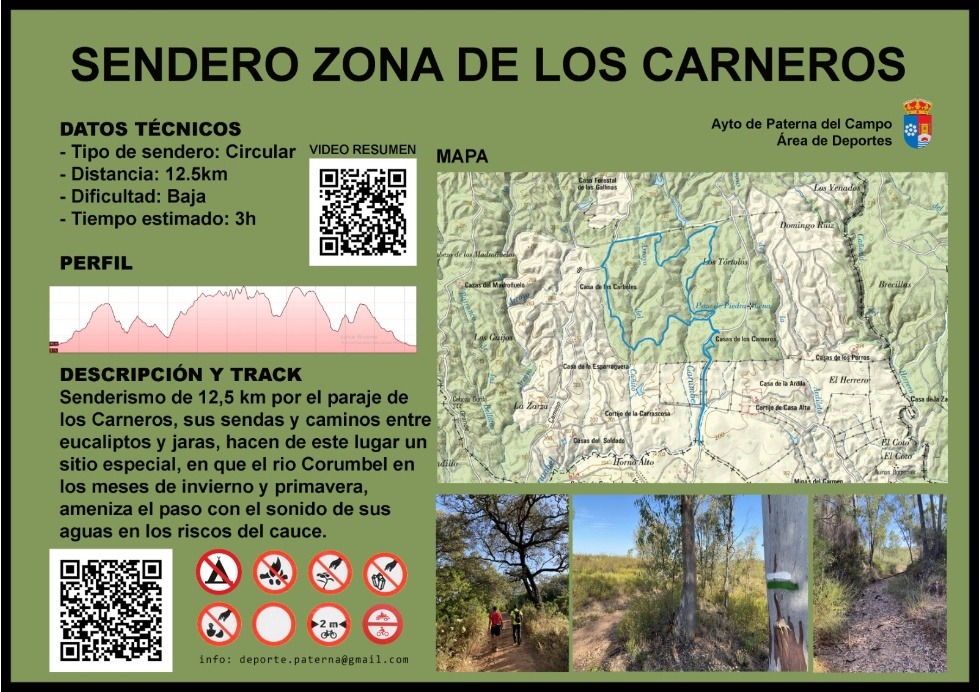
This is one of the easiest and least intense routes in the region. It is barely six kilometres long, with no inclines, and can be considered more of a pleasant stroll than a sporting challenge.
From the village of Tujena, where the Hermitage of San Isidro Labrador is located, take the HU-6108, turning left after one kilometre to take the Berrocal road. Follow this road to reach El Chorrito.
Along the way, you can enjoy a variety of landscapes. At the beginning, there are olive groves where partridges, terreras and little bustards roam freely. Little by little, the landscape changes, accompanied by the Corumbel River in the background. The cultivated fields gradually give way to eucalyptus groves, rockroses, mastic trees, palms and heather. Occasionally, an oak or cork oak tree claims its place in the landscape.
Almost at the end of the route, near the spring, the vegetation becomes more abundant and the smell of brambles and wild roses more intense, if possible. Finally, you reach a water source that flows from the limestone and above it you can see the caves that are characteristic of this enclave.
During the first weekend of October, Paterna del Campo hosts a major sporting event that turns the town into an international mountain biking hub: the Villa de Paterna Mountain Bike Route.
This route began in 2001, and its history shows how a town passionate about racing is capable of creating an event that puts it on the world mountain biking map. It has been part of the Spanish Bike Marathon Championship eight times, the UCI Marathon Series three times, the Spanish Bike Marathon Open three times and the Andalusian Open on numerous occasions. With these figures, it is clear that the Villa de Paterna Route is one of the most important bike marathon events in our country. In 2017, it took a big step forward, acquiring the status of a UCI event and becoming part of the International Cycling Union’s mountain biking calendar.
From its inception until the 2018 route, the main organiser was the El Cañonazo Cycling Club, always with the collaboration of the local council, some sponsors and, of course, the entire town of Paterna, which volunteers to actively participate in the organisation and cheer on the riders, who have grown to around 1,200 registered participants each year. In 2019, the Paterna del Campo Town Council took over the organisation, continuing to do so to this day.
In total, this race covers a distance of 85 km and starts at 9 a.m., following different trails through the historic region of Campo y Sierra de Tejada. One of the most important moments is the final stretch, with the legendary Cuesta de Pinguete, which has a gradient of 21%.