




Category: Villalba de Alcor
Ruta Sierra Norte
The Sierra Norte Route in Villalba del Alcor is an 11-kilometre itinerary of moderate difficulty that offers a unique experience by combining the agricultural wealth of the County of Huelva with the natural landscapes of the Huelva mountains. This route is ideal for those who want to explore rural environments and enjoy the local biodiversity.
The route begins on the road to Berrocal, leaving from Villalba del Alcor. The first section crosses agricultural countryside, characterised by dry crops such as cereals and vineyards, which reflect the agricultural tradition of the area. After crossing the Huelva-Seville railway line via a picturesque bridge, the asphalt road gives way to sandy and gravel paths, introducing walkers to a more natural and wild environment. As you progress, the landscape transforms into a mountain range with livestock and silvopastoral activity. At kilometre 5.2 is the Alcaboso stream, a highlight of the route that marks the entrance to areas of greater biodiversity.
The route offers a transition from agricultural land to more complex ecosystems, where it is possible to observe a variety of native flora and fauna. The presence of livestock and silvopastoral activities in the mountains contributes to the conservation of the landscape and local biodiversity.
Toro de cuerda
The Toro de Cuerda de Villalba del Alcor is one of the most unique, emblematic and deeply rooted bullfighting traditions in the province of Huelva. This festival, which has its roots in the 18th century and is closely linked to the arrival of the Carmelite community in the municipality, represents a unique cultural heritage that has been carefully preserved over the centuries.
The essence of this celebration lies in the controlled release of bulls through the streets of the town, where the animals’ movements are restricted by strong ropes, allowing direct but safe interaction between the bulls and the participants. This ancestral method guarantees both the excitement of the spectacle and the safety of all involved, combining tradition, respect for animals and popular entertainment.
Villalba del Alcor is currently the only municipality in the province of Huelva that keeps this ancient custom alive, making it a cultural and tourist landmark in the region. The festival takes place during the festivities in honour of the Virgin of Carmen, which are traditionally celebrated in August and September, and is one of the most eagerly awaited events for locals and visitors alike.
During the event, the bulls are released on a route through the main streets of the municipality. The runners, in a demonstration of skill and courage, challenge the animals, dodging them and skilfully escaping by climbing onto the railings and balconies of the houses. This dynamic interaction is the heart of the festival, creating an atmosphere charged with adrenaline and excitement.
The rope, which limits the movement of the bull, acts as a fundamental preventive measure. It allows the animal to be controlled and stopped if necessary, minimising risks and ensuring that the celebration takes place safely for participants and the attending public.
Fiestas del Carmen
The Feast of Our Lady of Mount Carmel takes place annually between the last weekend of August and the first weekend of September. This festival brings together residents and visitors in an atmosphere of tradition and conviviality.
Devotion to Our Lady of Mount Carmel in Villalba del Alcor dates back to the 17th century, coinciding with the founding of the Carmelite convent in 1618. Since then, this festival has been a fundamental pillar of the religious and cultural life of the municipality. The image of the Virgin of Carmen, carved by the sculptor Antonio Illanes in 1956, is venerated by the people of Villalba as a symbol of protection and faith.
The festival programme lasts for two consecutive weekends and includes religious, cultural and festive activities. The first weekend begins with the procession of the Queen and Ladies of Honour, followed by the release of the traditional bull with a rope through the streets of the municipality and culminating in a mass in honour of the Virgin in the convent, accompanied by a procession through the main streets.
During the second weekend, the image is transferred from the parish church to the convent. Likewise, during both weeks, the Popular Race is held, organised by the Town Council as part of the festivities.
This festival reflects the community spirit and devotion of Villalba del Alcor, where the streets are decorated with traditional decorations and the stalls offer a variety of food and leisure activities that reflect the rich local culture.
Fiestas de Santa Águeda
The Patron Saint’s Day celebrations in honour of Saint Agatha are one of the most significant celebrations in Villalba del Alcor. These festivities, which date back to the 14th century and have Castilian origins, are held around 5 February, the patron saint’s day, and last for several weeks with a programme that combines religious events, popular traditions and moments of conviviality.
Two weeks before Saint Agatha’s Day, the image of the saint is transferred from her chapel, located in the Llanos de Santa Águeda, to the Parish Church of San Bartolomé. During this period, a novena is celebrated in her honour, culminating in an emotional kissing of hands on the eve of her feast day.
5 February, the main day of the festival, begins with a floral dawn ceremony, followed by the Main Function of the Institute. In the afternoon, the image of Saint Agatha is carried in procession through the streets of Villalba del Alcor, accompanied by numerous faithful. During the procession, stops are made to honour the patron saint with fireworks, burning sticks and pyrotechnic displays. Before entering the church, in the church square, the traditional fireworks display takes place, and the bravest participate in the release of the fire bull.
A few days after the festival, the traditional Fiesta del Tostón is celebrated, coinciding with the return of the image of Santa Águeda to her chapel. After the formal ceremonies, families and groups of friends light bonfires in the Llanos de Santa Águeda to share the ‘tostón’, which consists of bread accompanied by sardines or cod, in an atmosphere of conviviality and celebration.
Feria de Santa Águeda
The Santa Águeda Fair, which dates back to the 14th century, is held annually during the second weekend of July in honour of Santa Águeda de Catania, patron saint of the town. This fair, which runs from Friday to Monday, takes place in the area known as the ‘Llanos de Santa Águeda’, an emblematic space for the Villalbera community.
On Friday, the festivities begin with the procession of the Queen and Ladies-in-Waiting, marking the official start of the celebrations. On Saturday, the traditional pilgrimage takes place, accompanied by the Nuestra Señora del Carmen Municipal Band, which parades through the main streets of the town. On Sunday, a mass is held in honour of the patron saint, followed by a triumphal procession through the fairgrounds, where the image of Santa Águeda is carried by the town’s inhabitants.
The Municipal Stand is open throughout the fair, offering a varied programme of musical performances and activities for all ages, creating a festive and convivial atmosphere.
The Santa Águeda Fair is a manifestation of the devotion and community spirit of Villalba del Alcor. During these days, the municipality is filled with colour and joy, with the active participation of residents and visitors in the various activities programmed. The streets are decorated with traditional decorations, and the marquees offer a wide range of gastronomic and leisure activities, reflecting the rich local culture.
Cruces de Mayo
The Cruces de Mayo (May Crosses) of Villalba del Alcor is one of the most emblematic and representative celebrations on the local festive calendar. This tradition, passed down from generation to generation, forms part of the municipality’s intangible heritage and reflects the collective sense of identity, faith and community that characterises the people of Villalba.
The festival takes place every weekend in May, during which time different neighbourhoods in the municipality are decorated to worship their respective crosses. Each of these celebrations has its own programme, organised by local brotherhoods and associations who, with great dedication, prepare religious events as well as cultural, musical and social activities.
During these days, Villalba del Alcor is transformed into a place of gathering and celebration, where neighbourhood participation takes centre stage. The streets are decorated with flowers, arches and altars, creating a festive and welcoming atmosphere that invites residents and visitors alike to share in this expression of popular devotion. In addition, traditional elements such as the Toro de Cuerda (rope bull), the dianas floreadas (flower-covered reveilles) and the romerías (pilgrimages) contribute to enriching this unique experience, in which tradition and joy go hand in hand.
Thus, the Cruces de Mayo are not only a tribute to the Holy Cross, but also a living expression of the soul of Villalba, where religiosity, culture and hospitality intertwine in one of the most eagerly awaited celebrations of the year.
Torre Alambique
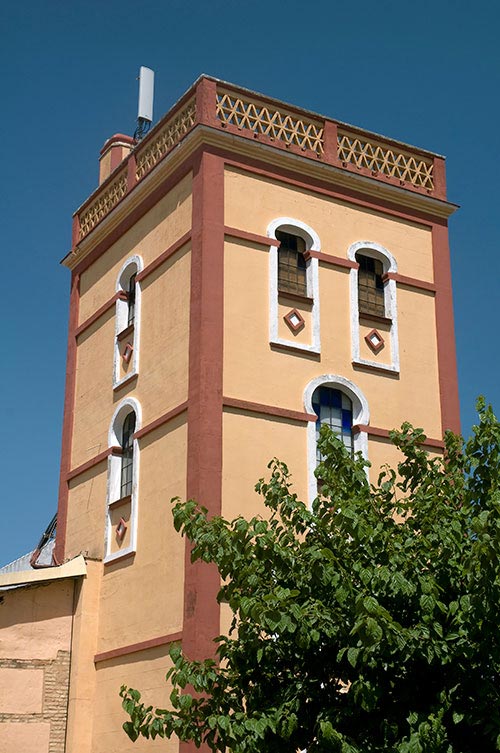
The Alambique Tower, built in the 20th century, is one of the most representative architectural elements of Villalba del Alcor. Located next to old wineries with a long tradition, this structure stands out for its uniqueness and relevance in the urban landscape of the municipality.
The tower has a structure composed of several sections that open to the outside through openings. On its roof, there is a chimney that, when in operation, was used to evacuate smoke from the alcohol distillation process. This architectural element is a clear example of the industrial architecture of the time, reflecting the importance of wine production in the local economy.
Convento de San Juan Bautista
The Convent of San Juan Bautista, also known as the Convent of the Discalced Carmelite Nuns, is one of the architectural and spiritual jewels of Villalba del Alcor. This monastery was founded in 1618 by the priest García Jiménez Franco, a native of Villalba and beneficiary of the cathedral of Cuenca, in Peru. The convent was founded in response to his desire to establish a Carmelite community in his hometown, following the reforms promoted by the Council of Trent.
The convent is organised around three courtyards: two single-storey courtyards with galleries of semicircular arches on pillars, and a third double-storey courtyard that houses the main cloister. In the centre of this cloister is a fountain crowned by the image of the Virgin of Carmen. The convent church has a rectangular floor plan, with the choir at the foot and a Mudejar coffered ceiling. The main altarpiece, built in the first third of the 18th century, is dedicated to Saint John the Baptist and the Virgin of Carmen.
The convent has been a centre of religious and spiritual life for the Villalbera community for more than four centuries. Throughout its history, it has undergone several renovations, notably the reconstruction of the bell gable and dome after the Lisbon earthquake of 1755. In 2019, the 4th centenary of the Carmelite presence in Villalba del Alcor was celebrated with a series of liturgical, cultural and social events that strengthened the bond between the convent and the local community.
Casas señoriales
The stately homes of Villalba del Alcor constitute a monumental complex of great historical and architectural value, reflecting the economic prosperity of the municipality during the 18th and 19th centuries. These buildings, located mainly along the old Calle Real, bear witness to the wealth generated by viticulture in the Condado de Huelva region.
They are built in the classic Andalusian style, with whitewashed façades, Arabic tiles and windows protected by latticework to ensure privacy and ventilation. Their façades combine Gothic and Neoclassical styles and, in many cases, are topped with ceramic altarpieces depicting religious images, giving each building a distinctive character.
Among the most representative stately homes in Villalba del Alcor is the Casa de Lizcano, one of the most emblematic houses, notable for its elegant façade and architectural details that reflect the wealth of its former owners. There is also the Casa del Cañón, known for its imposing structure and decorative elements that denote the economic power of the family that lived there. Finally, there is the Casa del Banco de Andalucía, a former financial establishment that demonstrates the commercial importance of Villalba del Alcor in times gone by.
These buildings are not only representative of the local economic boom, but also reflect a taste for refined architecture and a desire to flaunt social and economic status.
The tour of the stately homes of Villalba del Alcor allows visitors to immerse themselves in the history of the municipality, observing closely the architectural features that define its identity. The visit is free of charge, allowing visitors to appreciate the beauty and uniqueness of each building from the outside.