

Visita 360

Semana Santa

Holy Week in Hinojos is one of the most emotional moments in the municipality’s liturgical and cultural calendar. Through its different brotherhoods, the historical roots and deep popular religiosity that characterise this town in the County of Huelva are evident. This celebration, full of symbolism, artistic beauty and fervour, lasts from Holy Tuesday to Easter Sunday.

Holy Week in Hinojos begins on the evening of Holy Tuesday with the penitential procession of the Sacramental Brotherhood of Our Father Jesus Bound to the Column and Our Lady of the Angels. This is a leading institution in the municipality, whose sacramental roots date back to the 16th century, as attested by documents preserved in the Municipal Archive.

Currently, this brotherhood carries the image of Our Father Jesus Bound to the Column, attributed to the circle of Pedro Roldán, from the Brotherhood of Las Cigarreras in Seville. This carving was donated to Hinojos by the illustrious canon and local writer, Juan Francisco Muñoz y Pabón. The procession takes place after mass, and the route is accompanied by chapel music, to the Ermita del Valle chapel and back to the parish church of Santiago el Mayor.

Holy Thursday is dominated by the Primitiva Hermandad de la Vera+Cruz y Esperanza, considered the oldest brotherhood in Hinojos. As early as 1560, it appeared as an established brotherhood with its own chapel in the Ermita de San Sebastián, and its foundation dates back to the end of the 15th century.

In its origins, the Brotherhood processed with a Gothic image of Christ crucified, now preserved in the canonical headquarters of the brotherhood. The current carving of Christ, venerated as the patron saint, possibly dates from the 16th century or the 18th-century Genoese school. It is accompanied by the image of Nuestra Señora de la Esperanza, attributed to Gabriel Astorga in 1864.

The penitential procession takes place at 8 p.m. from the Ermita del Valle chapel and is one of the most solemn moments of the local Holy Week.

On Good Friday, the Brotherhood of the Holy Burial of Christ, the Risen Christ and Our Lady of Solitude takes centre stage. This institution has been documented since 1581 and is linked to the old hospital of Santiago, now the headquarters of the brotherhood.

Throughout its history, the celebration of the Descent has been a highlight, which is why the Recumbent Christ has articulated arms. In 1987, this brotherhood introduced a major innovation in Hinojos: carrying the floats with costaleros, which marked a turning point in the town’s Holy Week.

The procession departs from the Hermitage of Our Lady of Solitude at 10 p.m., notable for its aesthetic sobriety and spiritual depth.

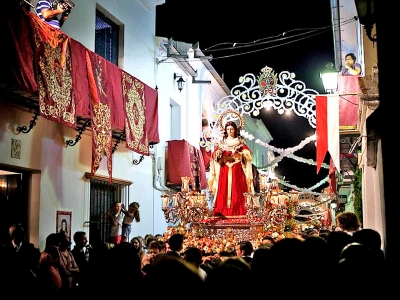
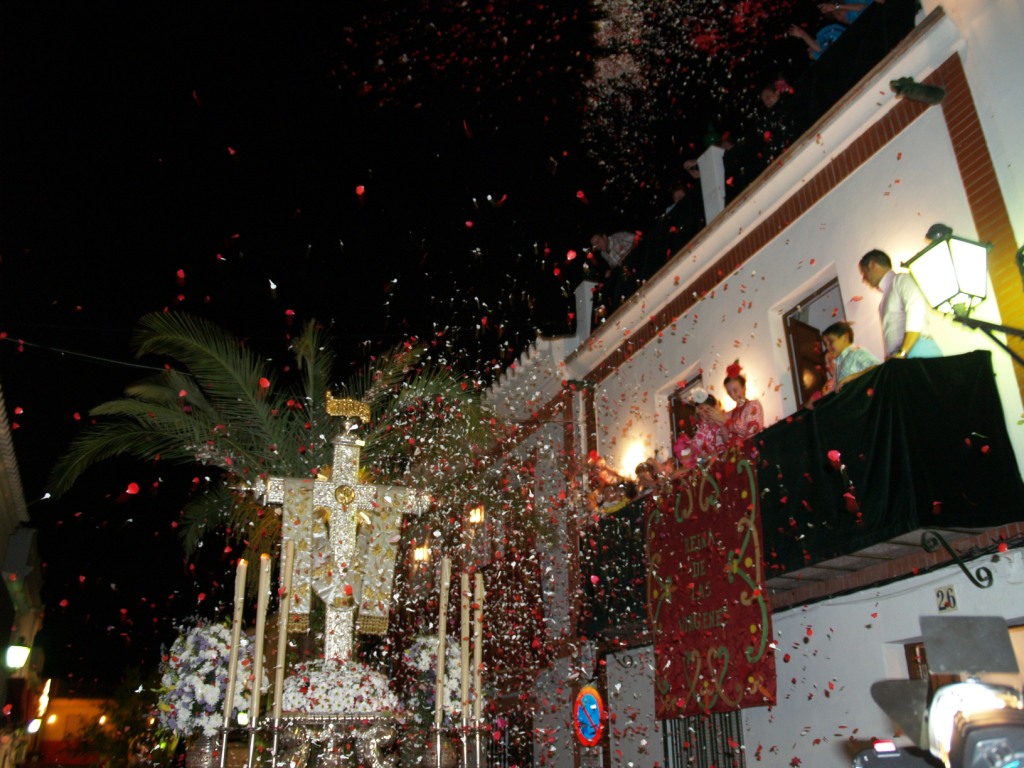
During the night of Holy Saturday, after the Easter Vigil, the chapel becomes the epicentre of one of the most unique and emotional scenes: the glorious departure of the Virgin of Solitude, who has exchanged her mourning clothes for the attributes of a queen. She is accompanied by the statue of Saint Mary Magdalene, carried by a group of children, and the image of the Risen Christ and King of the Universe.

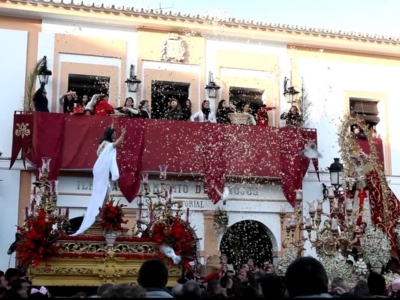
Accompanied by songs, clapping, processional marches and showers of petals, these images are transferred to the Ermita del Valle, where they await the dawn of Easter Sunday.

On that day, a unique and highly symbolic event takes place: the ‘tirada al Judas’ (shooting of Judas), in which a rag and sawdust doll dressed as Judas Iscariot is shot by dozens of hunters with real ammunition. This is followed by ‘Los Abrazos’ (The Embraces), an emotional re-enactment of the reunion between the Virgin Mary, Saint Mary Magdalene and the Risen Jesus.

The day concludes with a joint procession of the three images at 7 pm after the solemn resurrection ceremony, ending at the Soledad chapel.

Holy Week in Hinojos is much more than a religious event: it is a living expression of local identity, combining art, tradition, devotion and community. It is an essential experience for anyone who wants to discover the soul of this town in the Condado region.
Recogida de las Yeguas

The Collection of the Mares of Hinojos consists of gathering, selecting and transferring the horses from the Marisma Gallega (municipal property) to the livestock enclosure located in that town. This livestock activity is held the week before the Patron Saint’s Day celebrations in honour of the Virgin of the Valley (first weekend in September), when the Local Livestock Fair takes place.

There are no records of a livestock fair in the town until the second half of the 20th century, when the municipal corporation decided to revitalise the patron saint festivities of the Virgen del Valle with a large local livestock market that would attract visitors, according to the minutes of the town council meeting in 1943. This livestock fair was established in 1945 and was held every year to coincide with the patron saint’s festivities, as stated in the minutes of the ordinary session of 1945.

It is a day of conviviality in which livestock farmers and numerous residents of the town and surrounding area travel to the Marisma de Hinojos to collect the foals and mares, which are kept in the pens of the Choza del Pastor, and then take them to the town.

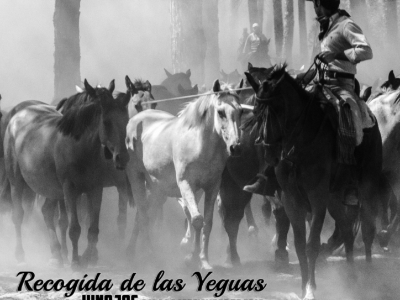
The day of conviviality takes place on Saturday and Sunday. On Sunday, at sunrise, the yegüerizos (horse herders) begin the task of moving the mares through the pine forests of Hinojos. At dusk, the herd of mares and foals receives a warm welcome from the town and, in the Plaza de España, greets the procession of the Hermandad del Valle and members of the Municipal Corporation before the image of Nuestra Señora del Valle, Patron Saint and Perpetual Mayor of Hinojos.

The herd then heads to the municipal livestock enclosure, where the cattle are put up for sale during the patron saint festivities.

Livestock farming dates back to the 16th century, as evidenced by a paragraph in the ruling of 10 April 1961 on the Marisma Gallega, whereby the Hinojos Town Council acquired the property rights, in dispute with the State.

For centuries, this activity was carried out to meet basic needs and was the livelihood of many families, hence the marketing of livestock at fairs.

In recent times, this concept has been transformed and now constitutes a festive event prior to the patron saint festivities. This is the approach that the livestock farmers of Hinojos took in 1991, giving rise to the Recogida de las Yeguas (Collection of Mares) that we know today. From this date onwards, livestock farmers began to move their cows, sheep and mares in an organised manner, although for health reasons, only equines are moved today.

Since 2013, with the aim of promoting the town’s festivities, Hinojos Town Council has been working to raise awareness of the event outside the municipality. This media coverage is attracting the attention of visitors, and every year more and more people come to see the arrival of the mares and foals, which encourages more people to visit our town at this time of year.

Over the last decade, the Town Council has expanded the activities within the framework of the Local Livestock Fair.

Procesión de Ntra. Sra. Del Rosario

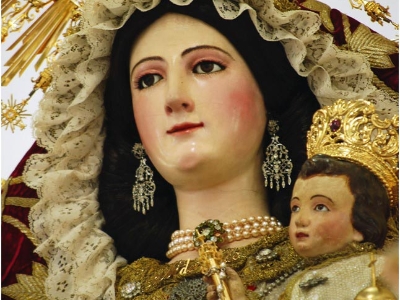
During the month of October, the Festivities in Honour of Our Lady of the Rosary are celebrated. It is the ‘month of the Holy Rosary,’ when the Brotherhood celebrates its services and festivities in honour and glory of its patron saint with a Solemn Triduum and Hand Kissing in Honour of Mary Most Holy of the Rosary and her Divine Child, as well as the Holy Mass of the Name Day of the Holy Patron Saint.

Devotion to the Holy Rosary in our parish and in our town of Hinojos dates back to before the 15th century, as recorded in the first Parish Inventory and in notes from the Protocol Archive of the City of Seville. This devotion came from the Dominican Order, which in those years owned land, livestock and oil mills a short distance from the current town.

Since that date, the ‘Brotherhood of the Holy Rosary’ has been recorded in our parish, with its chapel and headquarters inside the Parish Church of Hinojos. All of this is recorded in the parish inventory of 1500, as well as notes referring to this Brotherhood, the Holy Images of Our Lady of the Rosary and her Divine Child, and the extensive wardrobe of these Images. The Brotherhood was canonically established in 1583 and canonically confirmed by a papal bull issued in Rome during the pontificate of Pius VI. The bull dates from 28 August 1783, signed by Fray Bartolomé de Quiñones and registered by the Provisor of the Holy Land, Fray Luis Beltrán.

The current altarpiece, which replaces another mural behind it, dates from 1634. It was commissioned from the workshops of Diego Velázquez and Juan de Medina in the city of Seville. The paintings that adorn it are by the master Pacheco and others by the local artist Juan Romero de la Rosa.

Los Quintos

To understand the origins of the festival of ‘los quintos’ or ‘quintos mare’, as they were formerly known in the well-known songs that said ‘ya se van los quintos mare, ya se llevan a mi Pepe…’ (the quintos mare are leaving, they are taking my Pepe away…), we must go back to the time of the Civil War, when it became a deeply rooted tradition in our town.

At that time, military service was compulsory, and for many it was traumatic to have to leave their home environment to serve in the army.

The month of February was always the time chosen to celebrate a very special festival for the young men of the municipality who were entering military service that year.

The festival consisted of everyone gathering around a huge bonfire in the countryside for a long weekend. The wood used was donated by the local council for everyone to enjoy.

Warmed by the fire, fed and sheltered by the must of the land, songs were composed about the girlfriends of the conscripts. Always accompanied by the same melody, they created funny, mischievous lyrics that humorously described the different relationships and personalities of the protagonists of the conscription of that year.

The conscripts appeared riding on a trailer loaded with firewood, their faces and hands stained with indigo. They remained like this throughout the weekend that the festival lasted.

During the festival, usually during the daytime, the conscripts chased the local children to dye them blue. The children, in turn, teased the conscripts and engaged in a playful chase through the streets of Hinojos, in a kind of battle with blue dye as their weapon.

Today, the festival of ‘los quintos en Hinojos’ continues to maintain the same spirit as always, the same formula and the same joy that characterises it, with the difference, as could not be otherwise, of the incorporation of the women of Hinojos, giving the festival a greater richness of conviviality and entertainment in a weekend eagerly awaited by all.

Fiestas en honor a Santa María Magdalena

Hinojos celebrates the festivities and worship in honour of Saint Mary Magdalene around the weekend closest to her name day, 22 July. The image captures the attention and devotion of a large number of brothers and devotees who see the streets fill with joy and religious fervour before one of the Titulares of the Brotherhood of Soledad, Santo Entierro de Cristo, Cristo Resucitado, Santa María Magdalena and Santa Ángela de la Cruz, being one of the few towns in Huelva that celebrates worship of this saint.

In recent years, this celebration has undergone an interesting evolution that evokes the popular religiosity of the past, when the town prepared to receive the image of their devotion in their finest attire. In the days leading up to these festivities, the members of the Youth Group can be seen busily decorating the streets, giving them the joyful colour that characterises Hinojos during this summer event. This image is the devotion par excellence of the youngest members of the community, who are the undisputed stars of the religious services and the procession of the saint through the streets. Once again, this brotherhood infects the streets with its jubilant and popular way of living its religiosity.

Devotion to Saint Mary Magdalene is deeply rooted in this town due to the important role she plays every Easter Sunday in the Embraces, a unique ceremony in which this brotherhood celebrates the meeting of the Risen Christ with the Virgin Mary. ‘La Santa’, as she is popularly known, is the devotion par excellence of the youngest members of the community, as her youthful appearance conveys joy and happiness in her glorious celebrations, in contrast to the typical iconography with which Mary Magdalene is usually represented.

Fiesta a Ntra. Sra. del Valle

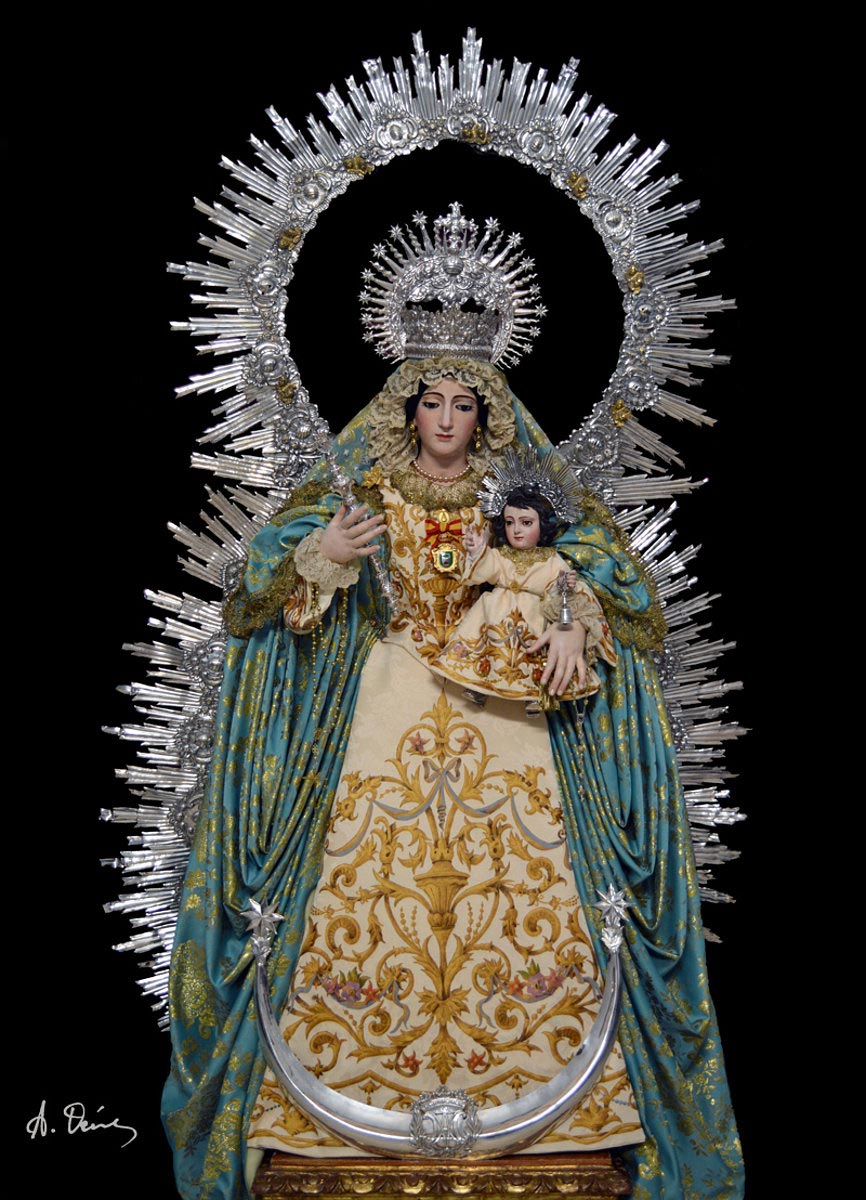
Held during the second week of September, the patron saint festivities of Hinojos are dedicated to Nuestra Señora del Valle. Based on more than five hundred years of documented history, devotion to Our Patron Saint has been established in her Mudejar chapel since time immemorial.

The Brotherhood of Our Lady of the Valley has its canonical headquarters in the chapel of the same name, built in her honour and of which she is the sole patron saint. The Virgin of the Valley is undoubtedly the oldest image in Hinojos’ religious heritage, an anonymous 15th-century work in the Gothic style.

Although the oldest documents we have date back to 1583, we can presume, according to popular saying that has been passed down from generation to generation, that this Brotherhood must have existed in Hinojos for a very long time, as is attested to by the valuable royal banners that are still preserved in its chapel and which, according to tradition, were donated to Nuestra Señora del Valle by King Alfonso X ‘the Wise’, who knelt before the Virgin in devout veneration and thanksgiving after his victory against the Saracens in 1253.

The main celebrations take place between August and September with the Solemn Novena, the kissing of hands, the proclamation of the patron saint festivities, the main ceremony and the procession, around the Feast of the Nativity of the Virgin (8 September).

As we have said, the patron saint festivities are celebrated in September, although the date has varied over the years. Initially, they were celebrated on the 20th, 21st and 22nd, and later postponed to the 23rd, 24th and 25th of the same month. However, these dates were not to the liking of the entire town, as they tended to coincide with the beginning of the autumn rains, the olive harvest was divided, the school year was paralysed and it did not always fall on a Sunday, which meant that the people of Hinojosa who lived outside the town or outsiders could not attend the festivities. For these reasons, the Town Council agreed that from 1966 onwards, the fair would be held on the second Sunday of September each year.

The religious nature of this fair was complemented, from 1948 onwards, by the economic nature of the local livestock fair. This fair had been in demand for years, as it was a way of boosting the economy and establishing a large livestock market. In that year, the corporation took charge of the public lighting, fireworks and all the services necessary for the installation of the livestock and watering places.

The municipal corporations have always taken a keen interest in the celebration of the patron saint’s festivities. In 1950, the first Municipal Festivities Committee was created with the aim of promoting the popular festivities related to Corpus Christi and the Virgin of the Valley. In that same year, considered holy by the Church (jubilee), the Town Council not only took charge of the secular part of the patron saint festivities, but also covered all the expenses and services required for the religious services, novena, solemn function and procession.

The location of the celebrations has also changed over the years. In the beginning, they were held on what is now Avenida de El Valle. They say that it was a more family-oriented, village-style festival that lasted all day. The Virgen del Valle was carried in procession in the morning, and the Seville band came to play, and everyone went dancing at the municipal marquee or the Brotherhood’s marquee. They remember how the stallholders sold fish and seafood in paper bags, and how the fair was enlivened by numerous activities such as horse and bicycle races, fun and eagerly awaited cucañas (greased pole climbing), balloon releases, a competition for couples dressed in Andalusian costume and a competition for embroidered shawls. In the evenings, there was a celebration and a wonderful fireworks display. We cannot forget the magnificent bullfights fought by the best bullfighters and novilleros of the time.

Later, as the livestock fair grew in importance, the grounds were extended to Avenida de los Reyes Católicos, where, with more space available, groups of friends gradually began to set up their own stalls. In the early 1990s, the new fairground was built and inaugurated, located on the site of the emblematic ‘Pino Gordo’ (Fat Pine Tree), which is full of private stalls.

The fair begins on the night of the pescaíto or lighting test on Wednesday and ends on Sunday at around midnight with fireworks.

El Romerito

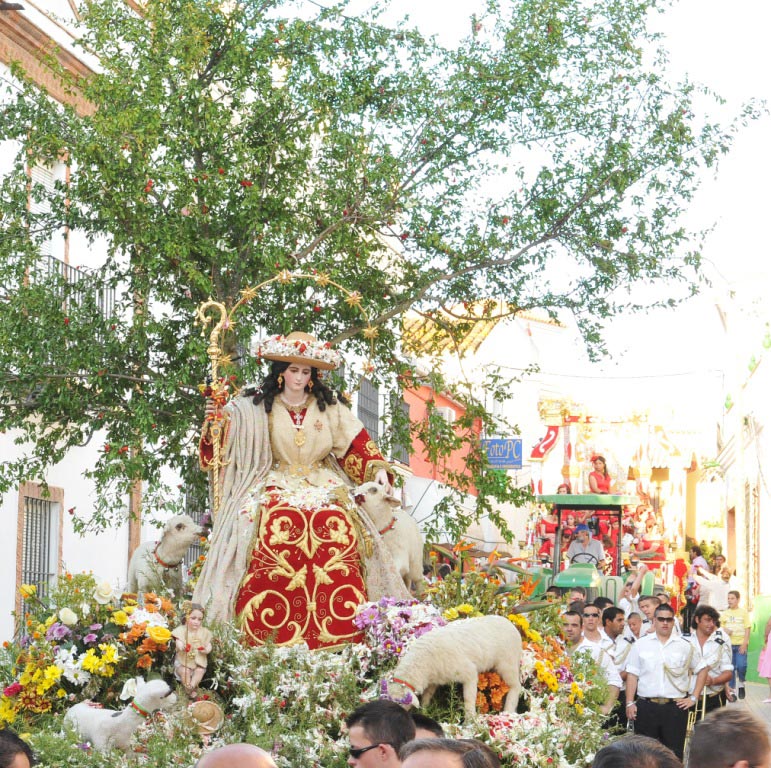
The Brotherhood of Vera+Cruz y Esperanza celebrates its pilgrimage at the end of June, popularly known as El Romerito. The tradition of honouring the Holy Cross in Hinojos dates back to the 16th century, according to historical documents. The image of the Blessed Virgin was incorporated into the pilgrimage in the first half of the 20th century, initially dressed as a queen and later as a shepherdess sitting on a cliff, surrounded by rosemary and wild flowers and under the biblical pomegranate tree. Beneath her feet, the Divine Shepherd Boy plays happily with the rosemary under the watchful gaze of his Mother.

Until the early 20th century, the pilgrimage took place in ‘La Vereda’ in Pilas, where participants went to cut rosemary, which would then be used as an offering to the Holy Images. From that moment on, both devotions, the Holy Cross and the Divine Shepherdess, have been inseparable in this celebration, this symbiosis being something very peculiar and unusual in the popular religiosity of our environment.

The parade consisted of horses and harnessed carts. In the second half of the 20th century, the floats that currently form part of the procession were introduced. Initially, they came from La Palma, but in the 1960s, the Brotherhood took over their production. This festival is a true reflection of the dual provinciality of our town: the glorious Holy Cross, in the style of Huelva, and the devotion to the Divine Shepherdess, which originated in the capital of Seville. This Romerito hinojero has been the subject of literature thanks to the pen of Muñoz y Pabón, a local author of costumbrista literature, who immortalised and praised it in 1920 in his work El Buen Paño, whose picturesque image was later echoed with admiration by the Cordoba realist Juan Valera.

The Romerito de Hinojos has been enriched over the years and has taken on greater luxury and splendour, but without detracting in any way from the popular and traditional flavour that has always characterised it, and despite the changes imposed by the passage of time, it has never lost the essence of its origins.
On Friday, the Pregón del Romerito (Romerito Proclamation) takes place in the parish church. In the evening, there is an orchestra and dancing until dawn at the Caseta de Vera-Cruz. On Saturday morning, the pilgrims set off for the pine forests to gather rosemary. At midday, the pilgrims return to the village and go to the chapel to offer a festive and joyful greeting to the Holy Cross and the Divine Shepherdess.

In the afternoon, the Holy Rosary procession departs from the parish church. An endless line of young women dressed in Andalusian costume make their way in a joyful procession to the chapel, where the triumphal departure of the Holy Cross and the Divine Shepherdess takes place. Before the passage of both images, the Children’s and Adult Queens are presented with their sashes. At the stroke of midnight, the sacred images are brought into the parish church and then the festivities continue at the Vera-Cruz marquee with an orchestra and dancing until dawn.

Early on Sunday morning, the band plays a joyful reveille. Horsemen carry the insignia of the brotherhood. Behind them, a flood of people of all ages jump, sing and dance to the music of the band, stopping at the doors of the Queens, who generously treat the attendees to traditional sweets from our town.

Around midday, the Reception of the Preaching Father takes place in the home of a local family. Then the solemn Mass of the Pilgrim is celebrated in the presence of the Holy Titulars.

In the afternoon, the Triumphal Departure of the Holy Cross and the Divine Shepherdess takes place. It is a unique moment full of fervour, enthusiasm and colour. The eight floats surround the square, which on this day looks more splendid than ever. There is no shortage of applause, cheers and sevillanas.

And that will be the atmosphere until they reach the doors of the Hermitage, where the Holy Titulars will be located to receive the Traditional Offering of the Pilgrim. Finally, there is a spectacular fireworks display, after which the Holy Cross and the Divine Shepherdess make their entrance into the Temple.

El Rociíto

El Rociíto is the oldest and most original children’s tradition preserved in Hinojos, a unique tradition that, without being supported by any brotherhood, association or entity, has emerged, developed and evolved naturally each year, undoubtedly thanks to the determination and perseverance of its founder, Carmen la Trianera, who died in 1991. Although today, the protagonists of this children’s tradition are increasingly participating in the events and worship of the Brotherhood of Nuestra Señora del Rocío de Hinojos.

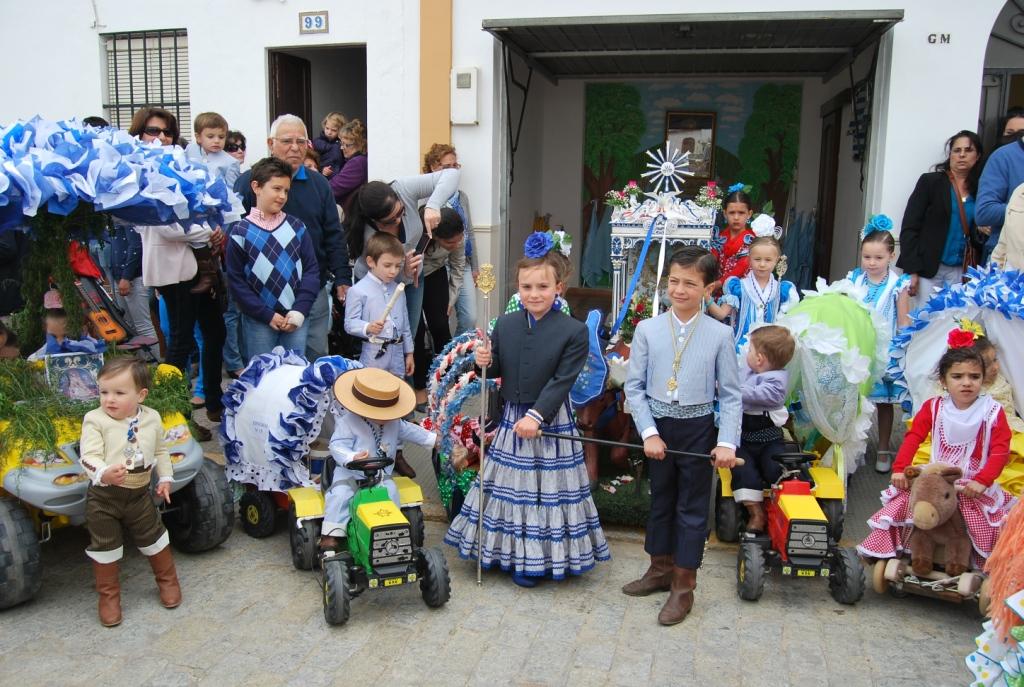
El Rociíto is a Hinojos tradition that has marked the childhood of the children of this town, as most of them have learned to be rocieros in this popular festival. When they are still unaware of the Romería del Rocío pilgrimage, boys and girls are dressed in flamenco costumes, flowers, accessories, short dresses, jackets… and, without missing a single detail, they take to the streets for a whole weekend, performing a procession as if it were the real pilgrimage.

At El Rocío, the respective Hermanos Mayores (Senior Brothers) are appointed, and their families, together with the Board of Directors, are responsible for organising the festival and the invitations offered to all attendees at certain times during the event, always coinciding with the Saturday and Sunday when the Hermandad del Rocío (Brotherhood of El Rocío) holds its religious services.

The Rociíto procession includes all the insignia, flags, banners and poles that parade in front of the Simpecado carried on a miniature ox cart, which is an exact replica of the wooden cart of the Hermandad del Rocío de Hinojos, well known for its neoclassical style and its white and blue two-tone colour scheme, the colours that identify the Hinojos brotherhood in the great pilgrimage.

And behind the cart comes the ingenuity and originality of so many fathers and mothers who make carts, tractors and trailers typical of the pilgrimage, in this case adapted to the size of the little ones, with toys as the star material throughout the procession.

Día de la Santa Cruz

To learn about the origins of the festival of ‘los quintos’ or ‘quintos mare’, as they were formerly known in the well-known songs that said ‘ya se van los quintos mare, ya se llevan a mi Pepe…’ (the quintos mare are leaving, they are taking my Pepe away…), we must go back to the time of the Civil War, when it became a deeply rooted tradition in our town.

At that time, military service was compulsory, and for many it was traumatic to have to leave their homes to serve in the army.

The month of February was always the time chosen to celebrate a very special festival for the young men of the municipality who were entering military service that year.

The festival consisted of everyone gathering around a huge bonfire in the countryside for a long weekend. The firewood used was donated by the local council for everyone to enjoy.

Warmed by the fire, fed and sheltered by the must of the land, songs were composed about the girlfriends of the conscripts. Always accompanied by the same melody, funny, mischievous lyrics were created, which humorously recounted the different relationships and personalities of the protagonists of the conscription of the year in question.

The quintos appeared riding on a trailer loaded with firewood, their faces and hands stained with indigo. They remained like this throughout the weekend-long festival.

During the festival, usually during daylight hours, the quintos chased the local children to dye them blue. The children, in turn, playfully teased the quintos and engaged in a game of tag, running through the streets of Hinojos in a kind of battle with blue dye as their weapon.

Today, the festival of ‘los quintos en Hinojos’ continues to maintain the same spirit as always, the same formula and the same joy that characterises it, with the difference, as could not be otherwise, of the incorporation of the women of Hinojos, giving the festival a greater richness of conviviality and entertainment in a weekend eagerly awaited by all.

Corpus Christi

Although different authors and researchers suggest different dates for the beginning of Corpus Christi in Andalusia, most agree that the festival became established in the 15th century. Seville has documented the procession in 1454, Jaén in 1464, Santa Fe at the end of the 15th century, Granada in 1501 and Baeza in 1504.

In Hinojos, it is documented at the end of the 16th century, although due to its links with the Brotherhood of the Blessed Sacrament, it could date back to the second half of the 16th century, when these brotherhoods, dedicated to the worship of the Eucharist, were established in many parish churches in towns and villages following the provisions of the Council of Trent (1546-1563). Nothing is known about the origins or date of foundation of this ancient ecclesiastical corporation, the historical predecessor of the current Sacramental Brotherhood of Our Father Jesus Bound to the Column and Our Lady of the Angels, although references in various documents show that it already existed in 1576, as evidenced by the will of a woman named Catalina Díaz, widow of Mr. Francisco Díaz Bejarano, who left ‘a piece of olive grove to the brotherhood of the Holy Sacrament of the Church of Santiago’ with the obligation to pay for masses each year. This donation was attested to by Mr. Francisco Panduro, priest of the parish church, and Mr. Miguel Díaz Bejarano, prioste and elder brother of the brotherhood.

The first documented reference to the Corpus Christi festival in Hinojos dates back to 1596 and reveals the importance of the procession, which the authorities of the brotherhoods were required to attend with their respective banners. The document in question, signed by the notary public Francisco Fernández, refers to the order given by the mayor of the brotherhood of La Sangre y la Santa Vera Cruz to the brotherhood’s prioste, Pedro Álvarez, to carry the banner in the procession on pain of a fine of two pounds, which the prioste refused to do, resulting in him being punished with the said fine.

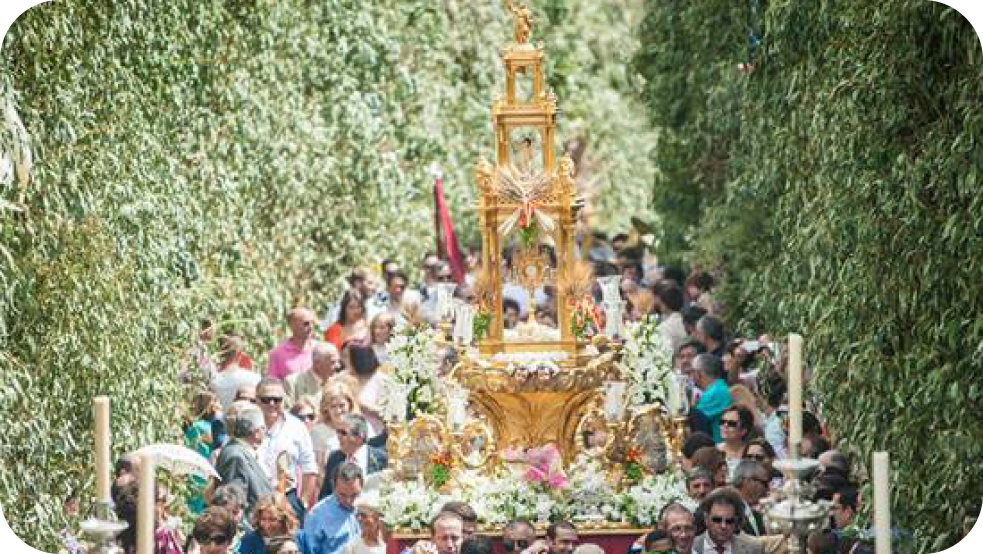
The custom of decorating the streets and the church square with rushes and bouquets has been recorded since 1636 in the parish’s factory books, although it is likely that the festive decoration of the space has been carried out since the early 17th century. The bouquets, whose variety is not specified in the parish books, were replaced by eucalyptus in the early decades of the 20th century, as can be seen in photographs from the 1920s. Oral testimony indicates that these eucalyptus branches were provided by the residents themselves, although according to municipal records, there were years when the council itself had them brought in to decorate the streets, in accordance with local custom.

With the reforestation of eucalyptus trees on the Montes Propios and Las Paredejas estates in the second half of the 20th century and the creation of a Festival Committee in 1950, Corpus Christi consolidated the unique feature that characterises it today: the transformation of its streets into a dense forest with its own values, in which floral arches are an expression of its identity.

The element that distinguishes the mode of expression in the Corpus hinojero arches is the floral arch. It is a creation composed of two long eucalyptus branches held at their ends and lined with bundles of rosemary. Its construction represents an aesthetic value that influences the perception of the whole. It is the selection of wild flowers and aromatic plants that each neighbour makes, but also the combination of this art that is developed to contribute to the collective experience.

The floral arch identifies popular religiosity at the neighbourhood level and marks the entrance to the house. Its expression is ephemeral because it is renewed every year. It is a fleeting art that builds a common language from the vernacular and speaks to us of lilies, thistles, palms, garlic, spinach seeds, thyme, pennyroyal… and a huge variety that unfolds to produce sensations.

Its expression appeals to the senses: sight, touch and smell, perceived with particular intensity due to the characteristics of the raw material. This is what leads people to enjoy the street and prolong the party until almost dawn.

At its meeting on 15 May 2018, the Governing Council of the Regional Government of Andalusia approved the registration of the Corpus Christi festival in Hinojos as an Asset of Cultural Interest in the category of Activity of Ethnological Interest.