Visita 360

Ayuntamiento de Manzanilla

The building that currently houses Manzanilla Town Hall is part of the former Osorno palace, whose properties occupied an entire block. This building was constructed on top of the Soledad chapel, dating from 1708.

It consists of a single nave with three sections, of which only one of the originals remains, covered with a barrel vault with lunettes and transverse arches. Also preserved from its former use is the main chapel, covered by a vaulted ceiling. All of this is preceded by a two-story corridor, both with three arches, the lower ones resting on white marble columns with claw bases and castanet capitals, and the upper ones on Doric-Tuscan columns.

The building began to be used as a town hall in 1929. In 1994, a complete renovation was undertaken, based on a project by Francisco José López Amate.

Circuito de velocidad Monteblanco

In the heart of the Condado region, the Monteblanco Speed Circuit stands as one of the most prestigious motor sports complexes in Andalusia and an international benchmark. Located in the municipality of La Palma del Condado, this circuit combines the excitement of motor racing with first-class facilities, making it attractive to both motor sports professionals and visitors seeking unique experiences.

Opened in 2006, Monteblanco has a 4,430-metre-long track, more than 20 different configurations and wide run-off areas that guarantee safety in every race. It is a venue approved by the FIA (International Automobile Federation) and the FIM (International Motorcycling Federation), which allows it to host international team training sessions, technical testing events, film and television shoots, as well as corporate activities.

Thanks to its privileged climate and strategic location between Seville and Huelva, the circuit is chosen every year by numerous brands in the automotive and motorcycling sector to carry out development tests and presentations of new models.

Beyond its function as a leading technical centre, the Monteblanco Circuit opens its doors to the general public with exciting proposals. From free practice sessions for amateur drivers to extreme driving experiences, driving courses, corporate team building events and exclusive events for groups, the circuit offers the chance to experience speed in a controlled and safe environment.

It also regularly hosts sporting events open to the public, such as competitions, exhibitions and classic or sports car rallies, which are an added attraction for visitors to La Palma del Condado.

The venue has professional pits, a press room, a restaurant, training rooms and large spectator areas. All this is surrounded by a natural environment that respects the values of environmental sustainability, with energy efficiency measures and noise control.

The Monteblanco Circuit is located just 5 km from the town centre of La Palma del Condado, with direct access from the A-49 motorway that connects Huelva with Seville. These excellent transport links make it easy to visit, both for those staying in the region and for day trips from other Andalusian provinces.

Visiting the Monteblanco Speed Circuit is a unique opportunity to discover the world of motor racing from the inside, in a professional and accessible environment. A different way to complement your visit to La Palma del Condado, where the passion for speed is experienced with safety, excitement and quality.

Contact: info@circuitomonteblanco.com | +34 959 40 41 70

Monumentos conmemorativos

The Hinojos Memorial Route takes visitors on a tour of different areas of the municipality where public art bears witness to local history, religious devotion, cultural identity and the values shared by its residents. It begins in the town centre, in Príncipe de Asturias Square, where the monument to Diego Franco Izquierdo stands. He was an illustrious resident who, with his legacy of land and economic resources, contributed to the well-being of the town, and whose generosity lives on in the collective memory of Hinojos. This work is by Martín Lagares.

Nearby, on one of the main roads, is the Monument to Peace, dating from 2006. This four-sided pyramid by Francisco Talavera represents the transition from dictatorship to democracy. The route continues to Calle Ntra. Sra. de la Soledad, where the monument to Saint Angela of the Cross, inaugurated in 2011, is located. The work of sculptor Martín Lagares, it was promoted by the Brotherhood of the Holy Burial of Christ and Our Lady of Solitude as a sign of the municipality’s deep devotion to this Sevillian saint.

Crossing the Plaza de España, at the junction of Calle La Fuente and Calle Manuel Rubio Díaz, we find the monument to the Sacred Heart of Jesus, dating from 2023.

If we head towards El Valle, we find the monument in honour of the Virgin of Hope, Divine Shepherdess of Souls, of the Vera+Cruz y Esperanza brotherhood. The monument, made of aged ivory cream marble, was created by Mármoles del Nido.

The next point of interest takes us to the municipal cemetery, where the same sculptor created the figure of the Guardian Angel in 2014. This work was conceived as a tribute to those who rest in this graveyard and as a symbol of comfort for their families, who find in this image a serene representation of hope. The route then heads to the entrance of the fairgrounds, where the monument to ‘El Fanega’ stands, a Marismeño horse that represents the prototype of this native breed so closely linked to farm work and the Doñana environment. The sculpture, by Pedro Germán Casado, extols the strength, nobility and resilience of an animal that is an inseparable part of the local landscape and culture.

The route ends at one of the main entrances to the town, where the Obelisk of Hinojos stands, with bas-reliefs at the bottom depicting traditional work and crowned by the town’s coat of arms.

The route, which is accessible and suitable for all audiences, offers a close-up view of Hinojos’ sculptural heritage and a different way of discovering the essence of the town through its most symbolic monuments.

Iglesia de Santiago el Mayor

Entre los edificios más emblemáticos de Hinojos destaca la Iglesia Parroquial de Santiago el Mayor, declarada Bien de Interés Cultural por su valor arquitectónico, artístico e histórico. Es uno de los mejores ejemplos conservados del gótico mudéjar sevillano del siglo XV, y representa fielmente el estilo que caracterizaba a las iglesias andaluzas antes del terremoto de Lisboa de 1755 y de la posterior proliferación de torres campanario.

El templo presenta planta basilical de tres naves cubiertas con armadura de madera de tradición mudéjar, y su portada principal, de estilo ojival, muestra un arco apuntado y abocinado, cuya última arquivolta, tallada en piedra con motivos en punta de diamante, se combina con ladrillos bicromos que le confieren un singular valor estético.

El interior de la iglesia alberga un destacado conjunto de obras escultóricas y pictóricas que abarcan varios siglos. Entre ellas, sobresalen tallas del siglo XVI del círculo de Juan Bautista Vázquez el Viejo y Jerónimo Hernández, así como otras del siglo XVII atribuidas a escuelas vinculadas a Martínez Montañés y Pedro Roldán. También se conserva una valiosa tabla del siglo XVI que representa la “Incredulidad de Santo Tomás”, pintada por Alejo Fernández. Detrás del retablo mayor, enmarcado en un arco apuntado y rehundido, se puede admirar un fresco del siglo XV que representa a Santiago el Mayor en la batalla de Clavijo, imagen titular del templo y patrón de la localidad.

Uno de los episodios históricos más relevantes vinculados a esta iglesia tuvo lugar el 24 de noviembre de 1490, cuando los Reyes Católicos pernoctaron en su interior durante su viaje hacia Palos de la Frontera, procedentes del antiguo camino de Mures, actual Villamanrique de la Condesa.

La sacristía conserva un importante conjunto de orfebrería religiosa: cálices, portapaces y una cruz parroquial de plata datada en 1641, obra de Pedro Sánchez y restaurada en 1695 por Juan Laureano de Pina. También destaca un crucifijo de bronce dorado, atribuido al círculo de Francisco de Alfaro, hacia 1585.

En la actualidad, la Iglesia Parroquial de Santiago el Mayor acoge la sede canónica de varias hermandades y agrupaciones religiosas de Hinojos: la Hermandad de Nuestra Señora del Rosario, la Hermandad Sacramental, la Hermandad de Nuestra Señora del Rocío y la Agrupación de Fieles y Devotos de Santiago Apóstol, que mantienen viva la tradición y la espiritualidad de este lugar.

Ermita del Valle

The Chapel of Nuestra Señora del Valle, located on the outskirts of the town of Hinojos, is one of the most historic and devotional temples in the municipality. It was first documented in 1582 with the dual dedication to Saint Sebastian and Our Lady of the Valley. At that time, it was also the headquarters of the Brotherhood of the Blood of Jesus Christ, known today as the Brotherhood of Vera+Cruz.

Its architectural structure is typical of the 15th-century Mudejar style, with elements that reflect the transition to Renaissance forms. Over the centuries, the chapel has been shared between two brotherhoods: Nuestra Señora del Valle and Vera+Cruz. This shared use was formalised on 4 April 1773 by a conservation agreement and is currently governed by an episcopal decree dated 11 February 1985.

The main altar is dedicated to the patron saint of Hinojos, the Virgin of the Valley, a 15th-century Gothic-style image on a candlestick, restored in the 20th century by sculptors Sebastián Santos and Juan Manuel Miñarro. The accompanying carving of the Child Jesus dates from the 18th century. Tradition has it that it was this image that King Alfonso X the Wise venerated after the reconquest of Hinojos. At the foot of the chapel, two old flags can be seen, preserved in display cases, which refer to this event and could explain the origin of the municipality’s name, either because of this legend or because of the abundance

Ermita de la Soledad

The Chapel of Nuestra Señora de la Soledad, located in the town centre of Hinojos, is one of the most important religious and heritage sites in the municipality. Its origins date back to an old hospital for beggars linked to the Order of Santiago, which gives it special historical and spiritual value.

There is evidence of the veneration of Our Lady of Sorrows in its chapel as early as 1710. Its exterior architecture preserves a 17th-century side doorway as a testament to its original construction, an element of great artistic and heritage interest.

The interior of the chapel houses a main altarpiece made in 1966 by the Huelva sculptor Antonio León Ortega, which contains several images of notable value: the Virgin of Solitude, a 17th-century candlestick image attributed to the circle of Pedro Roldán; the Recumbent Christ, an anonymous carving from the same century; and the Resurrected Christ and Saint Mary Magdalene, 18th-century sculptures that enrich the devotional ensemble.

The chapel also stands out for its important collection of paintings, which combines classical and contemporary works, such as a copy of Rubens’ canvas ‘Rest on the Flight into Egypt with Saints’, preserved in the Prado Museum, made in 1896 by the painter A. Silvera; or a magnificent reproduction of Murillo’s work in the Hospital de la Caridad in Seville. In addition, contemporary paintings by local artists can be seen, such as Francisco Talavera Lozano (The Virgin with the Cris

Barrio del Cerrillo

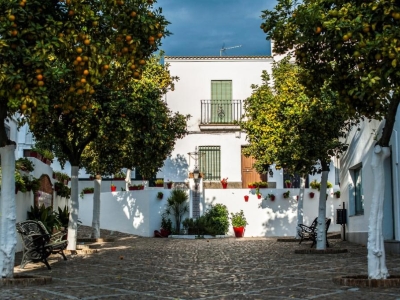
A particularly beautiful part of the village of Hinojos is the neighbourhood of El Cerrillo, a typically Andalusian corner with beautiful courtyards with orange trees and fountains, whitewashed houses, orange trees, geraniums, brightly painted Andalusian railings…

The El Cerrillo neighbourhood is a good example of a typical Andalusian hamlet, home to farm workers in this village dedicated to agriculture and forestry.

Its modest buildings are single-storey with a gallery structure. They usually also have a courtyard with orange trees that fill the spring air in Hinojos with the scent of orange blossom.

This is one of the oldest neighbourhoods in the town. But where it really stands out is in its popular beauty, looking more like a film set than a place where people actually live.

Located in a central area of the town, it is quiet, making it a pleasant place to take a stroll as a starting point for exploring Hinojos.

Its small squares, with their whitewashed tree trunks, invite you to rest in the summer shade, when the sun beats down mercilessly on the whole county.

Sometimes beauty does not have to be majestic; it is dignified in its humility and captivates with its popular simplicity. Here, in El Cerrillo, you will feel at home. Take the opportunity to make friends, something that the people of Hinojos are very fond of.

Tejada la Vieja

Tejada la Vieja is a pre-Roman archaeological site founded in the 8th century BC during the Phoenician colonisation of the south-western interior of the Iberian Peninsula. Its emergence as a settlement is explained by its proximity to the mining operations in the district of Aználcollar and Río Tinto.

The site is listed as a Site of Cultural Interest in the category of archaeological area and Protected Landscape of Andalusia. It is frequently cited in scientific studies. It is the only Tartessian city to have been extensively excavated, with ongoing excavation campaigns since the 1980s led by the Provincial Council and the University of Huelva.

The most characteristic feature of Tejada la Vieja is its wall. It was built in the 8th century BCE using a technique that has clear construction references in the eastern Mediterranean and is the oldest element dated at the site to date. It is therefore believed that, since its origins, Tejada la Vieja has been influenced by the East, due to its contact with the Phoenician world, and that its emergence was planned, because the wall, as an urban element, would predate the city itself.

Tejada la Vieja provides very relevant information about protohistoric urban planning. It is exceptional due to the degree of preservation of its structures and, above all, due to its size. Currently, more than one hectare has been excavated, which is, however, only a small part of its archaeological potential.

Iglesia del Divino Salvador

The Parish Church of the Divine Saviour is the main religious temple in Escacena del Campo. It is a building constructed between the 15th and 18th centuries, which has undergone several renovations over time.

The church has a structure with three naves separated by pillars and covered by groin vaults. The chancel consists of a square main chapel with two side chapels. On the outside, the main doorway stands out, built in the Mannerist style, with a semicircular arch between Tuscan columns and a triangular pediment.

Another characteristic feature of the building is its tower, which stands at the foot of the church on the left-hand side. It is a brick construction with several sections separated by cornices and topped with a pyramidal spire.

Inside, the main altarpiece is Baroque in style and houses the image of the Divine Saviour. Other religious images of interest are also preserved, as well as various altarpieces and decorative elements typical of Andalusian sacred art.

The church is listed in the General Catalogue of Andalusian Historical Heritage, which highlights its historical, artistic and cultural value within the context of the County of Huelva.

Fuente del Atanor

The Fuente del Atanor fountain is located next to the old Ororuz orchard and, although the date on its structure is 1943, its origins date back to the 15th century, when it was used to supply water to a community of Franciscans of the Observance who settled in the area after 1453.

The fountain is shaped like a trough and is decorated with a ceramic altarpiece depicting Our Lady of the Moon, patron saint of Escacena. This element stands out not only for its architectural simplicity, but also for the spiritual aura it conveys.