Visita 360

Acantilados del Asperillo

Between the towns of Matalascañas and Mazagón, following the Cuesta Maneli trail, lies the Acantilado del Asperillo Natural Monument, a system of fossil dunes stretching along twelve hectares of coastline.

It is considered one of the most unique coastal formations in terms of geomorphological and ecological characteristics on the Peninsula, as it is a sandy cliff formed by the sedimentation of wind-blown and alluvial sand, organic matter, and other materials. The different layers were deposited over time, and then the forces of the earth raised them more than 100 meters. The oldest materials are estimated to be between fourteen and fifteen thousand years old.

The waves and wind cause continuous changes in these dunes. From the long beach, you can see the different shades of orange, white, ochre, and black that stratify on their walls, creating whimsical undulations and geometric shapes interrupted by gullies. The profile is notable for its almost complete lack of vegetation due to the harsh coastal conditions and steep slopes. At the top, settled in the sand, there are gorse, sea lavender, junipers, savin junipers, and reforested stone pines. This tree’s roots fix the sand in place, preventing the dunes from advancing. These environments are home to endangered species such as the spur-thighed tortoise, the snub-nosed viper, the Iberian lynx, and the mongoose. Venturing in to contemplate the landscape or bathe on one of its beaches are some of the options for enjoying this protected natural area.

Torre Zalabar

From the sea, this tower offers a view that deceives the human eye into believing that it stands in perfect condition, “protected” by thick vegetation of barrón, camarina and some stunted abulaga. However, as we approach the coast, we can clearly see its destruction. This tower had slightly buttressed walls and a single chamber 4.20 metres in diameter covered by a semi-spherical dome. Unlike its sister towers, its construction was rather deficient, as evidenced by the large breach affecting a third of its perimeter, which is nothing more than a symptom of the poor workmanship of the oyster stone masonry and the mediocrity of the materials such as rubble and mortar used to erect it.

Documents from 1756 mention that the tower showed no signs of having had artillery, hence the recommendation to equip it with light eight-calibre cannons.

At the end of the 1990s, it collapsed due to the ravages of time.

Torre San Jacinto

The San Jacinto Tower is one of the buildings that has stoically withstood the passage of time and inclement weather. Its structure is located between the last line of coastal dunes at the tip of Malandar and the first line of stone pines that dominate the forests of Doñana.

From its vantage point, the entire coastline and the mouth of the Guadalquivir River could be seen.

It is now some distance from the coast, due to sand accumulations that have altered the configuration of the coastline. The tower is a truncated cone 15 metres high from the cornice to the base. It is accessed through a hallway, which opens onto a 7-metre diameter vault covered with an elliptical dome. In the centre of the chamber is the mouth of a cistern or well 0.80 metres wide, which allowed the garrison to fetch water without leaving the stronghold.

Structurally, it is in good condition, although several accessory elements such as steps, battlements and guardrails have disappeared or are deteriorated as a result of climatic factors such as humidity and erosion, as well as the effects of vegetation.

The historical information that still survives shows that they had a storehouse for 30 quintals of gunpowder. It is said that the powder magazine had a wooden structure on stilts, built by Juan Bautista de Bussy in May 1742.

Torre del Río del Oro

The Torre del Río de Oro, popularly known as the Torre del Loro, is a watchtower declared a Site of Cultural Interest, located on the border between the municipalities of Palos de la Frontera, Almonte, Moguer and Lucena del Puerto. It gives its name to the beach of Torre del Loro. It lies in ruins next to the mouth of a stream, between the Atlantic coast and the foot of the cliff.

The tower was mentioned at the beginning of the 16th century as a powerful watchtower, but a report by Pedro Mateos in 1748 describes the serious damage caused by a storm to the tower’s foundations, threatening to ruin up to a third of them.

In the previous decade, storms had exposed the tower’s foundations, causing alarm, but another storm covered the gap opened by the first, so the alarm was silenced. Both repairs had the technical complication of reinforcing the foundations on the firm ground of a tower located on sand and completely surrounded by the sea at high tide. The solution employed was to create a lining of oyster stone blocks up to a height of seven metres. In 1756, the long-term ruin of the tower was considered inevitable due to its location, surrounded by water and only accessible at low tide. However, the renovations carried out in previous years meant that in 1764 it was observed to be in good condition. In 1827, it was still listed as an active tower in Sebastián Miñano’s Geographical-Statistical Dictionary of Spain and Portugal, although by 1867 it was already listed as in ruins in the coastal charts.

Torre de la Higuera

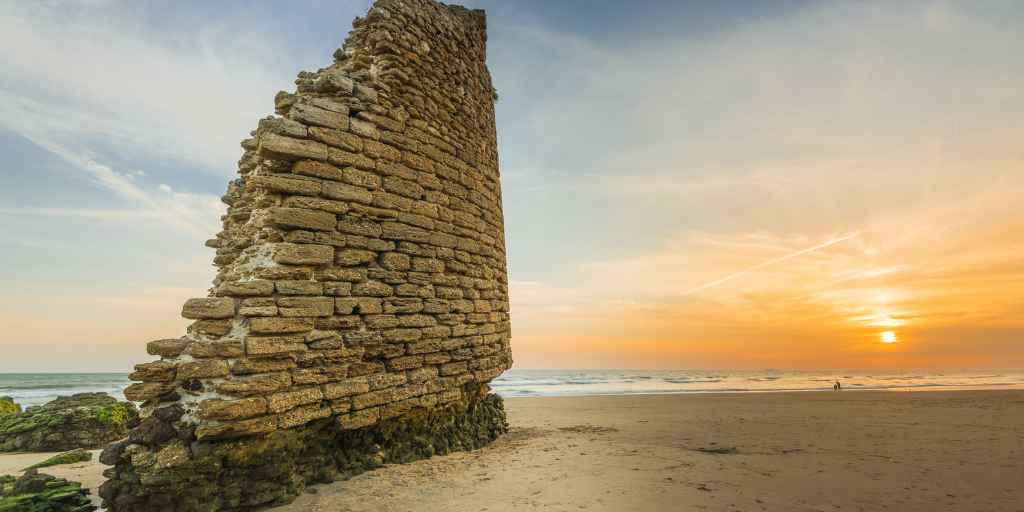
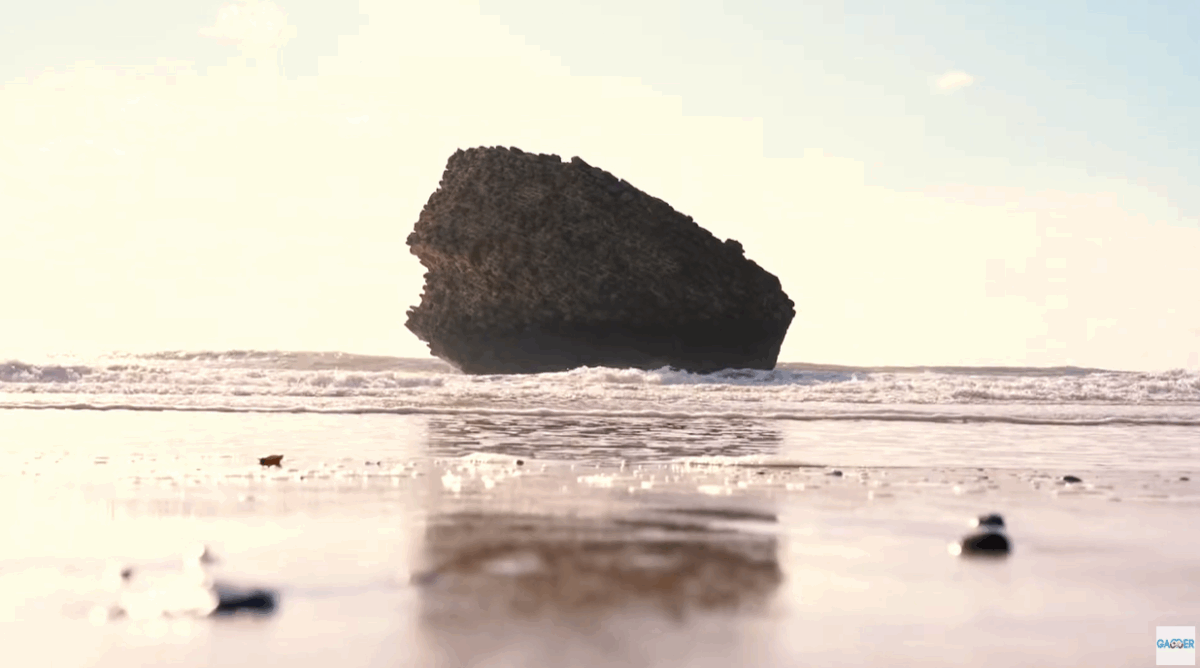
Today, the remains of the tower are a tourist icon in Matalascañas, the most characteristic symbol of the beaches of Doñana and a landmark for those who visit it. In addition, there is something that makes it unique compared to its contemporary infrastructures, and that is its inverted position, in which the part visible to the human eye shows the widening of the circular plinth and the foundations of the tower. It is beneath this structure that its walls lie, stripped bare by the passage of time and the constant action of the tides and waves that continuously break over it.

Despite maintaining a position that leaves it at the mercy of sea erosion, the tower retains its structure in its “overturned” state after having tilted from the top of the cliff on the Arenas Gordas stretch of coastline.

Documentary reports from 1756 explain that the tower, ‘located on the edge of the ravine, fell onto the beach’ as a result of a storm that stripped away the sand foundation that supported it.

When the watchtower infrastructure was planned in 1577, special mention was made of the strategic location of the area as it was home to fishermen who were subjected to “undesirable” visits from Barbary ships.

Nowadays, there is a widespread belief that the 1755 tsunami was responsible for the collapse of this tower, which crowned the cliff on La Higuera beach. However, this is nothing more than a legend forged during the 19th century that lacks any historical basis. In the historical geographical dictionary of Spain, compiled by Pascual Madoz in 1845, it is said that on the Almonte coast there are “six towers equidistant from each other, one to two leagues apart, which were built in the Middle Ages: Today, almost all of them have been destroyed, and the one called La Higuera, having been unable to withstand the onslaught of a strong hurricane due to its foundations being undermined, or as a result of a major earthquake, fell without losing its shape. It is currently still standing, but with its foundations raised and the tower itself buried in sand. This unique position has given rise to conjecture in the country, accompanied by fantastic stories and tales.

Torre Carbonero

Torre Carbonero is one of the fortifications that has undergone the least environmental changes over the last four centuries. With its well-known truncated cone shape, it stands 15.60 metres high from its profile to the circular plinth at its base. It is built of plastered rubble masonry. The opening or entrance to the tower is located on one side, 7.20 metres above the current ground level. The tower is accessed through a hallway that leads to a segmental vault. Documents from 1577 detail the suitability of building an ‘ordinary tower’ with the characteristic vault or floor plan because, given the fertility of the aquifers and the presence of wells on the lands of the Duke of Medina Sidonia, it could be a strategic location in that ‘enemy ships often come there’ to replenish their fresh water supplies.

In 1756, it was recommended that the infrastructure be equipped with a light eight-calibre cannon.

Santuario Nuestra Señora del Rocío

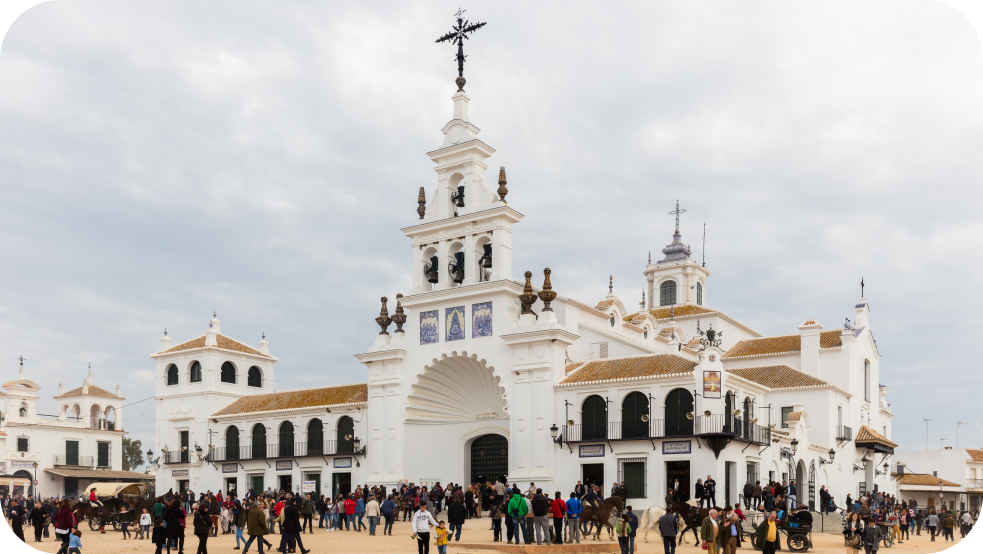
According to legend, a chapel dedicated to the Virgin of El Rocío was built in the 15th century on the marshes of Doñana. Several centuries later, it was decided to build a grand sanctuary to replace the original one in a different location. The work took place between 1964 and 1969, due to the growing devotion to this image and the need for a building suitable for a pilgrimage. The architects responsible for the sanctuary were Antonio Delgado Roig and Alberto Balbotín de Orta.

The building consists of a group of structures in which the temple is inserted. It is a basilica-style church with three naves, a transept and a chancel. All these architectural and decorative elements are in the purist classical Baroque style. Designed in the style of an Andalusian farmhouse, its exterior surprises us with its beautiful bell gable, topped by a wrought-iron cross. The entrance is covered by a scallop shell that welcomes pilgrims and is an emblematic landmark among the marshes. In recent years, the Hermandad Matriz de Almonte has enriched its heritage, notably with a spectacular Baroque altarpiece that houses the image of Nuestra Señora del Rocío.

This emblematic image appears to have been sculpted in the late 13th century in the Gothic style, although it underwent significant alterations in the 17th century. It was dressed in rich fabrics, in keeping with the fashion of the Habsburg court. It consists of a dress with a flared skirt and fitted sleeves. Her head is covered by a cloak and framed by an oval face with a rostrillo, derived from the pointed or lace headdress. Along with the dress, the hands and the Child must have been reworked. It is possible that, from then on, the eyes took on their sweet downward gaze, instead of the frontal gaze typical of Gothic imagery. The face, however, has Gothic features: a sharp profile, a straight nose and an archaic smile.

Monumentos conmemorativos

The people of Almonte have never ceased to embellish the streets and squares of their town, commemorating what they are most proud of with monuments.

One of the most beautiful is the monument to the grandmothers of Almonte, a sculptural ensemble created by local artist Curro Báñez at the end of the 20th century in homage to these women of Almonte. It depicts a group of women from Almonte carrying the ornaments of the Virgin of El Rocío (crown, halo, crescent moon, jugs, etc.) on foot. They accompany her on her journey to Almonte when she is carried in procession dressed as a shepherdess every seven years (the Virgin wears a traveller’s outfit, typical of the 18th century). This tradition is over 200 years old. The work is located on the Camino de los Llanos, the road along which the Virgin comes from Almonte and which the monument faces, symbolising the devotion of these women. There is a wooden copy of this work in the Town Museum.

Another notable monument is ‘A las Yeguas’ (To the Mares), which represents the Saca de Yeguas (Mare Drive) that has been celebrated since the Middle Ages during the last weekend of June. Made of bronze, it depicts the mare driver and the mare with her foal on their way from Doñana to Almonte.

The monument to the Apparition of the Virgin is one of the most beloved by the people of Almonte. It depicts the Virgin of El Rocío dressed as a shepherdess on a tree trunk. At her feet kneels a hunter, just as the legend tells of the apparition of the Virgin.

In the Virgen del Rocío square, opposite the Church of the Assumption, there is a monument dedicated to the Virgin herself. Dressed as a shepherdess, as she is only during the transfer, it reminds us that this is where she is kept in the village every seven years.

Another example is the monument to the Heroes of Baler, dedicated to José Jiménez Berro, who resisted alongside his comrades for 336 days in the church of Baler (Philippines), surrendering in June 1899, some time after peace was signed with the United States.

Also noteworthy are the monuments commemorating illustrious figures from the municipality, such as Rafael Torres Endrina, Lorenzo Cruz, Martín Villa and Sebastián Conde.

Monument to the Virgin of Pastora

The Virgin of El Rocío, patron saint and protector of Almonte, is depicted wearing her Pastora attire, which she wears only every seven years during the procession from the village of El Rocío to Almonte. At its base, you can see three Sevillanas sticks alluding to the Virgin and, on the fourth, facing it, the dedication of the town of Almonte to its patron saint. It is at this monument that the local children make a floral offering in honour of the Virgin. This takes place on the Monday before Pentecost Monday, when the pilgrimage is celebrated.

Monument to José Jiménez Berros

José Jiménez Berro was born in Almonte on 7 February 1876 and was one of the 33 Heroes of Baler (Luzon, Philippines), as designated by the Ministry of War in 1899. The son of a humble peasant family, he entered the draft lottery in 1895 and was assigned to the Overseas Army, one of the most feared by young men given the warlike atmosphere of independence in the Spanish colonies. Besieged with his comrades in the small church of Baler, he resisted the Philippine troops for 336 days, even after peace had been signed with the United States.

Puerta de la Mar (Sea Gate)

This monument was built in memory of the gate which, according to the minutes of the Almonte Town Council, was constructed in the early 17th century when a plague epidemic was declared and it was necessary to control entry and exit from the town to prevent the spread of the disease.

Monumento Bendita Aparición (Blessed Apparition Monument)

Image of the Virgin of El Rocío dressed as a shepherdess on a tree trunk from which human heads emerge as if holding her on their shoulders, representing the legend of the Virgin’s apparition to a hunter in the Rocina area.

The whole ensemble stands at the foot of a representation of the façade of the old chapel, where the tiles depict the Canonical Coronation of 1919 and the famous photo of the Olivarejos Bridge during the Transfer of 1972.


Iglesia de la Asunción

The Church of La Asunción is surrounded by numerous stately homes and is close to the Town Hall, the former Cabildo (town council) and the Hermitage of Santo Cristo. It is located in the Plaza Virgen del Rocío, which highlights its majesty, its white colour and the purity of its lines. The trees in the square, the flowerpots and the gardens surrounding the parish church give an Andalusian touch to this emblematic building in Almonte.

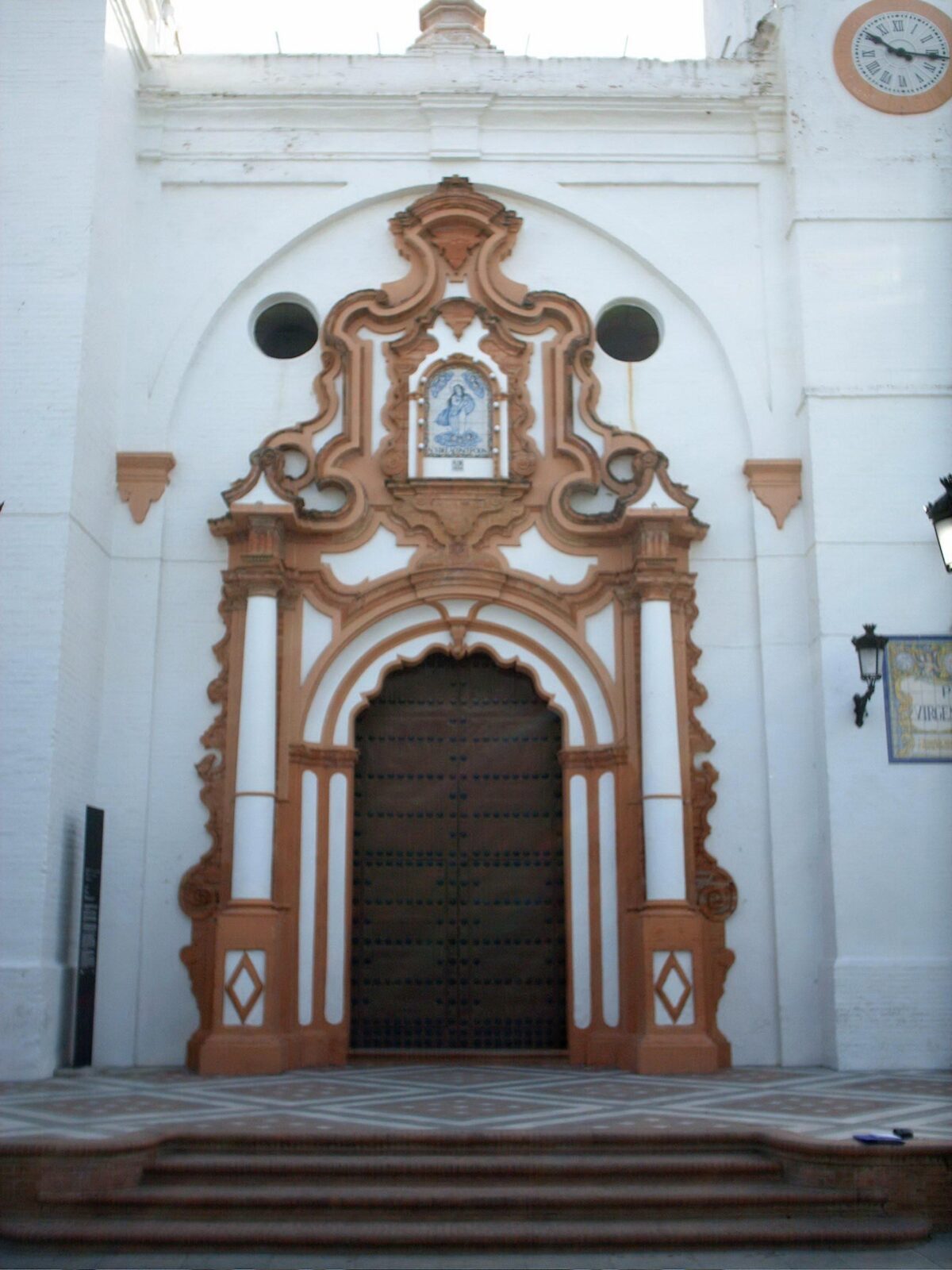
The original temple was built between the 15th and 16th centuries, a period from which it retains a Mudejar-style chapel. It was remodelled between the 17th and 18th centuries, giving it its current Baroque appearance, with the façade by Antonio Matías de Figueroa standing out.

It has a basilica floor plan with three naves separated by pointed arches that support a wooden gabled roof.

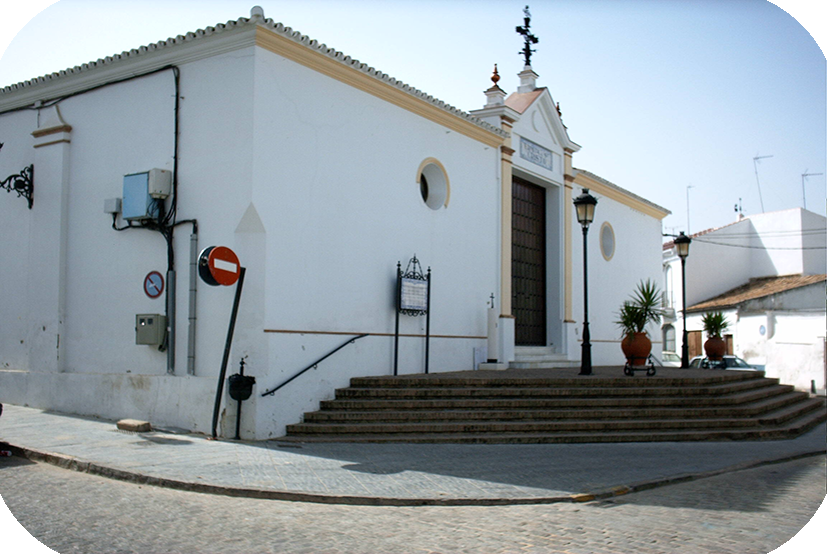
Ermita del Sto. Cristo

It was formerly the chapel of Saint Sebastian, dating back to the 15th century. It is dedicated to the image of the Holy Christ of Vera Cruz, to whom it was consecrated once the cult of Saint Sebastian declined.

The chapel has two parallel naves separated by a central arcade of three pointed and double arches, which rest on rectangular pillars with attached pilasters. It has a gabled roof and two double pointed arches with alfiz linking the two chancels.

The image of the Holy Christ is located above the main altar, framed by a pointed arch. The entire building stands on a wide staircase, and the entrance door is located on one side.