Visita 360

Corpus Christi

Corpus Christi is undoubtedly one of the most charismatic festivals in Bonares. Corpus Christi is a Christian festival celebrating the Eucharist. The celebration takes place on the Thursday following the eighth Sunday after Easter Sunday (i.e. 60 days after Easter Sunday).

Here in Bonares, this celebration has a special feature that makes it unique: balconies are decorated with their finest mantles and the streets are covered with a carpet of green rushes and pine branches on the facades.

It is a great pleasure to stroll through the streets on the morning of Corpus Christi and feel the freshness and aroma of the rushes, a truly memorable experience.

On the other hand, once the procession is over, there is a very special custom of making a zurriago (a kind of braided whip made from rushes). Late in the afternoon, all the children begin to make their own rush beds, where they play on them.

Velás de San Antonio y San Juan

The festivals of San Antonio and San Juan are celebrations centred around tiles, which have been venerated by the people since ancient times.

The tile of San Antonio is a ceramic altarpiece, by an unknown artist, depicting San Antonio de Padua holding the crowned Baby Jesus. It is framed by pilasters and a pink marble cornice, and crowned by a marble plaque with a Latin inscription alluding to the origin of the monument. Devotion to the tile of San Antonio is one of the most deeply rooted in Bollullos, being an object of daily veneration by residents and visitors alike. Every 13th of June, in his honour, the traditional Velá de San Antonio is celebrated, a festival with more than 250 years of history. In 2024, to mark this anniversary, the Town Council awarded the city’s gold medal to the Private Association of the Faithful of San Antonio.

For its part, the tile of San Juan was declared an Asset of Cultural Interest in 1982. The image represents Saint John the Evangelist and is framed in an architectural ensemble of exposed brick. This tile is the epicentre of the Velá de San Juan, a festival celebrated on 24 June that includes activities such as the burning of satirical figures made by the residents, known as ‘juanillos’.

The velás de Santa Ana and Santiago (25 to 27 July) and San Miguel (29 September) have not survived the passage of time.

Semana Santa

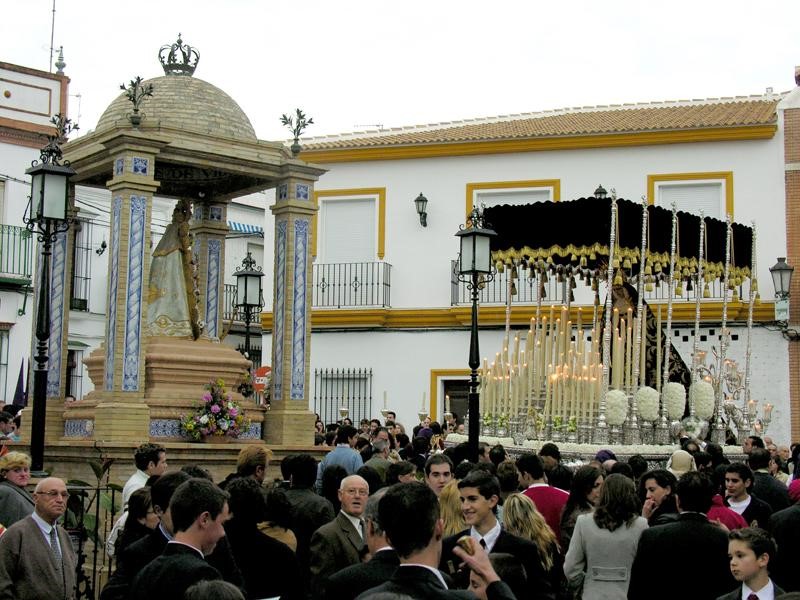
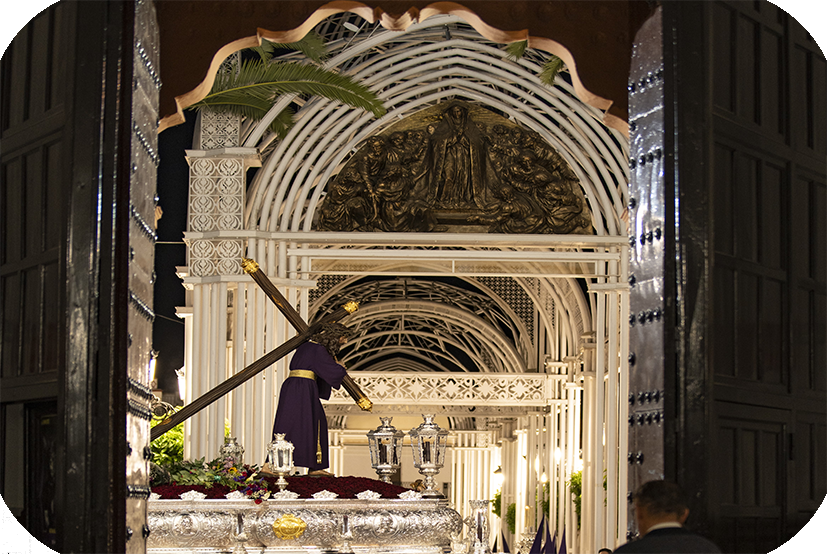
Holy Week in Bollullos Par del Condado is a manifestation of faith, art and tradition deeply rooted in the hearts of its people. During these days, the town is transformed into a scene of contemplation and solemnity, with each day having its own identity and emotions. The brotherhoods and guilds, with centuries of history, parade through the streets with floats laden with symbolism, followed by the faithful and curious who join in this religious and cultural event.

Holy Week begins on Palm Sunday with the procession of the Brotherhood of the Holy Entry of Jesus into Jerusalem, popularly known as ‘La Borriquita’, accompanied by children dressed as Nazarenes.

On Holy Monday, the Brotherhood of Our Father Jesus in his Arrest and Holy Mary of Bitterness processes through the upper part of the town.

On Holy Tuesday, it is the turn of the Brotherhood of Our Father Jesus Cautivo and Our Lady of Victory, notable for its contemplation and silence.

On Holy Wednesday, the Brotherhood of the Holy Christ Bound to the Column and Our Lady of Mercy holds its procession.

The Brotherhood of the Holy Christ of Vera Cruz and Our Lady of Hope performs its penitential procession on Holy Thursday.

In the early hours of the morning, the Brotherhood of Our Father Jesus Nazarene and Holy Mary of Pasmo travels through the streets in one of the most emblematic processions.

Holy Week culminates on Easter Sunday with the procession of the Brotherhood of the Holy Burial of Christ, Holy Cross on Mount Calvary and Solitude of Mary Most Holy in her Sorrows and Joys of Our Lady in the Glorious Resurrection of the Lord.

Holy Week in Bollulla is distinguished by the active participation of the community, where residents of all ages are involved in the organisation and development of the processions. The streets are filled with sacred music performed by local bands, and traditions such as the use of Nazarene tunics and the accompaniment of floats with saetas (religious songs) are maintained.

Quema de las Gaminotas

The Burning of the Gamonitas is an ancient tradition celebrated every 7th of December in Bollullos Par del Condado, on the eve of the Feast of the Immaculate Conception. Dating back more than 160 years, this festival combines religious and pagan elements, marking the start of the Christmas celebrations in the town.

The tradition dates back to the mid-19th century, when a cholera epidemic struck the Condado region. According to legend, the locals lit bonfires with aromatic plants, such as thyme and rosemary, to purify the air and ward off the evil spirits responsible for the disease. Over time, these bonfires evolved into the burning of gamonitas, bundles made from the Asphodelus ramosus plant, known as common gamón or “St Joseph’s wand”.

On the night of 7 December, after evening mass, the residents light candles in the streets and squares of Bollullos. The gamonitas, previously collected and dried, are used as torches which, when burned, illuminate the town with a characteristic reddish glow. This celebration also includes traditional songs performed by the campanilleros, who keep alive a musical tradition dating back almost four centuries.

La Quema de las Gamonitas is recognised in the General Catalogue of Andalusian Historical Heritage, highlighting its importance as a manifestation of the region’s intangible heritage. In addition to its historical and cultural value, the festival promotes intergenerational coexistence, as children, young people and adults actively participate in the preparation and development of the event.

Feria de septiembre de nuestra Señora de las Mercedes

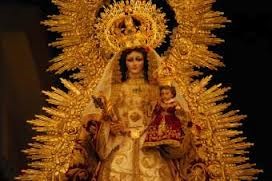
These festivities are held annually from 12 to 16 September. The 12th is the most significant day, as it is dedicated to the patron saint, Our Lady of Mercy. On this day, a solemn religious service is held in the parish church of Santiago Apóstol, followed by a procession carrying the image of the Virgin through the streets of the town.

The fair opens with the traditional parade of Giants and Bigheads, known locally as ‘fantoches’, who walk through the streets announcing the start of the festivities.
The fair is closely linked to the region’s wine culture. During the days of celebration, local wine tastings are held in the marquees at the fairgrounds. In addition, the traditional Regional Fruit Competition is held.

Día de San Sebastián

Every year on 20 January, the feast of Saint Sebastian is celebrated, also known as ‘Chorizo Day’. On this day, residents head to San Sebastián Natural Park, a communal pasture that welcomes thousands of people. There, they spend the day with family and friends, enjoying food brought from home. There is no shortage of morcones (sausages), chorizos (spicy sausages), or San Sebastián breads or ‘roscas’ (ring-shaped pastries).

Since the 1920s, a song has been sung on this day that refers to San Sebastián Day in Bollullos. It is a Carnival song written by José Acosta ‘Acostita’, a famous and renowned comparsista (Carnival singer) of the time, who was also mayor of the municipality. The lyrics are as follows:

‘On San Sebastián Day, we went to the countryside to eat the chorizos of all the years. I know a girl, you see, you see, who went home crying her eyes out. And she said to her mother, “Mum, I want a chorizo of a quarter and a half.” And her mother said, “I have it here, but you don’t have any money, and that’s for me.”’

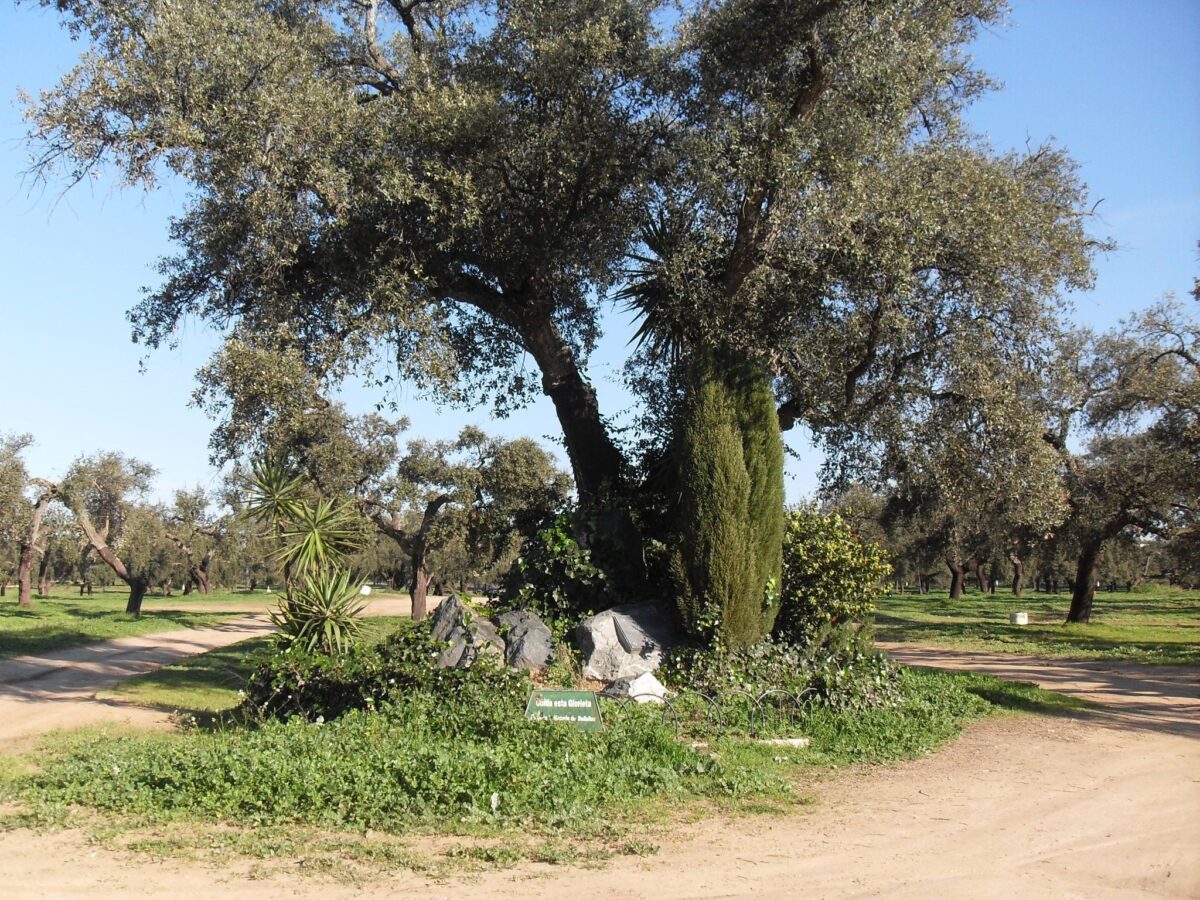
The San Sebastián Natural Park is a communal pasture on the outskirts of the municipality, characterised by a huge cork oak forest that is protected by environmental regulations.

It is a bucolic setting where various activities take place, including the famous “Day of the Sausages” or “Day of San Sebastián”, a day of celebration coinciding with the feast day of the saint who gives the park its name.

According to the latest research by several local historians and researchers, this festival may have religious origins, but during the 20th century it became secularised and took on its current form: a day of family and neighbourhood gatherings in which typical products from the pig slaughter are tasted (the main one being the ‘chorizo de guita’, which has become the slogan of the festival), the latest wines from the harvest and the famous ‘naranjas del país’ (local oranges).

With regard to its history, it is worth noting that during the 20th century, the mayor of Bollullos until 1945, D. Manuel Pérez García, initiated a socio-popular struggle to transfer the pastureland, previously owned by the Isern Coto family, to public ownership. The campaign arose as a reaction to the continuous loss of cork oaks due to the planting of eucalyptus, an invasive species. In 1980, the cause was taken up by the San Sebastián Natural Park Association, which succeeded in acquiring 18 hectares in 1983 and another two in 1984 for the construction of the current children’s playground. Finally, in 1989, the land was transferred to the municipality and became public property.


Cruces de Mayo

Over time, the Cruces de Mayo have evolved into a living manifestation of the spirit of Bollullos. They are not only religious events, but also a reflection of the soul of the town, where neighbourhoods are actively involved in decorating streets, adorning crosses with flowers, organising processions and celebrating gatherings that strengthen community ties.

In Bollullos there are four recognised crosses, with brotherhoods or associations that ensure their conservation, worship and procession: Santa Cruz de la Calle Santa Ana, Santa Cruz de la Calle Niebla, Santa Cruz de Montañina and Santa Cruz de la Calle de las Mercedes. The latter is not currently carried in procession but continues to be celebrated with religious and cultural activities, keeping its essence alive.

Carnaval

This festival of pagan origin, celebrated before Lent in Bollullos, differs from the carnival in the cinema, where troupes, chirigotas and quartets perform for four days in the Casa de la Cultura, and the street carnival. The latter consists of several parts: the day of the procession or ‘day of the streets’, when the municipal corporation parades through the streets decorated for the occasion with street groups and brass bands; Children’s Day, or Carnavalito, when the little ones also take part in a parade in costume; and Parade Day, the big day of the carnival in Bollullos, when a parade, accompanied by chirigotas, comparsas and street groups, winds its way through the streets of the town until it reaches the municipal marquee, where games and competitions are organised.

The origins of this festival are lost in time, with the carnivals of the early 20th century being particularly noteworthy. Authors such as Acostita, El Porquino, El Chamarín and El Realista stand out from this period. There are also two lost traditions, such as the day of the tizne or tizná or the crossing of flags, which was celebrated in the Arenal (now Plaza de la Piña), and in which the most important comparsas competed before the public to see which one attracted the most support. The arrival of the Civil War and the subsequent Franco dictatorship led to the disappearance of this festival, of which only the piñatas that were broken on the Sunday before Lent and the songs that were sung semi-clandestinely on the feast of Saint Sebastian, the prelude to the festival, remained as a reminder, as it is on this day that the first songs are ‘unveiled’.

Semana Santa

Holy Week in Almonte has grown in importance over the years thanks to the efforts of the residents themselves, who have worked hard to make it a significant event.

Holy Week in Almonte begins on Palm Sunday with the popular procession of La Borriquita, accompanied by children dressed as Nazarenes carrying palm leaves and olive branches. It continues on Wednesday, when visitors can enjoy the Brotherhood of El Cautivo and María Santísima del Rosario. The following day is Maundy Thursday, during the early hours of the morning, with the procession of El Gran Poder and Nuestra Señora de la Quinta Angustia, commonly known as El Silencio. On Friday, visitors can enjoy the Cristo de la Vera-Cruz and Nuestra Señora de los Dolores, ending on Saturday with the processions of the Brotherhood of Santo Entierro and Nuestra Señora en su Soledad.

Easter Sunday is very special in Almonte, as the Hermano Mayor (Grand Master) of the Hermandad Matriz de Nuestra Señora del Rocío (Brotherhood of Our Lady of Rocío) is chosen, who will be in charge of leading the people of Almonte to prostrate themselves before the Blanca Paloma (White Dove).

Saca de las Yeguas

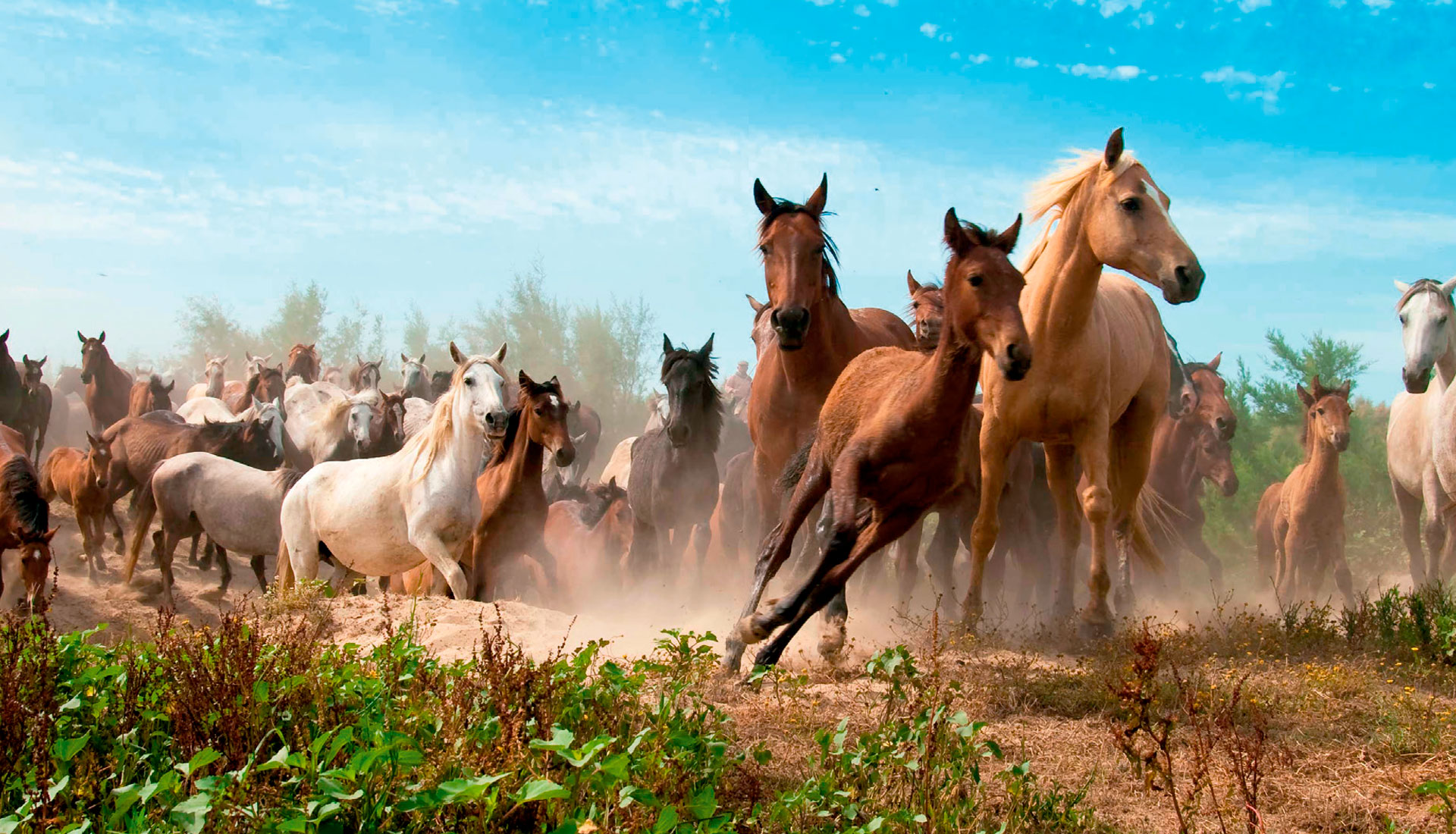
The Saca de las Yeguas (Mare Drive) is one of the most emblematic traditions of the town of Almonte. There are numerous ancient historical references that attest to this event as an ancestral livestock event, which was officially regulated in 1504 by the Ordinance of the Duke of Medina Sidonia. This ordinance mentions the figure of the ‘yegüerizo’ (mare herder) and establishes that the livestock should be moved from the enclosed pastures to Almonte, coinciding with the feast of Saint Peter, patron saint of the town.

The following day, in the municipal enclosure known as the ‘Huerta de la Cañada’, after the animals had been distributed among the pens, the selection of mares and foals took place, along with the branding of the young foals and the sale of some of the animals.